This scenario plays out daily across Manhattan's commercial construction landscape. HVAC value engineering (VE) offers a strategic solution—not a compromise. It's a structured process that identifies cost-saving alternatives while preserving system performance, code compliance, and design intent.
This article explains what HVAC value engineering is, why Manhattan's unique construction environment makes it essential, which systems can be optimized, and how to evaluate a qualified VE partner.
TLDR:
- HVAC value engineering replaces equipment and methods with performance-equivalent, lower-cost alternatives—not "cheapening"
- Manhattan's premium labor rates, tight spaces, and Local Law 97 penalties amplify HVAC costs, making VE critical
- Typical savings range 15-35% of HVAC budget through equipment selection, duct redesign, and controls optimization
- Most effective during pre-construction phase before permits are filed
- Choose VE partners with multi-manufacturer access, NYC DOB expertise, and documented savings track record
What Is HVAC Value Engineering?
HVAC value engineering is a structured process of analyzing every component of an HVAC scope to identify alternatives that deliver equivalent or better performance at a lower cost—without sacrificing code compliance, system reliability, or design intent.
The core distinction between value engineering and "cheapening" is this: VE replaces like-for-like in function, not in brand name or specification. Building occupants experience no change in comfort or performance.
A properly executed VE process maintains the same BTU capacity, airflow rates, SEER/EER efficiency ratings, and code compliance as the original specification. The only thing that changes is the cost.
Typical areas VE examines include:
- Equipment selection (manufacturer/model alternates)
- Duct routing and material choices
- Control system specifications
- Installation methodology
The best time to apply VE is during the pre-construction or estimating phase, before permits are pulled and scopes are locked. Late-stage VE yields diminishing returns because design changes trigger costly Post Approval Amendments (PAAs) with NYC DOB, adding $100 PAA fees and administrative delays to an already tight schedule.
A legitimate VE proposal gives building owners and general contractors full visibility to make informed decisions. It should include:
- Documented scope breakdowns showing line-by-line changes
- Alternate equipment submittals with performance comparisons
- Revised pricing with warranty coverage and lead time differences noted
Verbal promises of savings aren't enough. Written documentation is what separates real VE from a budget cut in disguise.
Why HVAC Value Engineering Matters More in Manhattan
Manhattan's commercial construction environment amplifies HVAC costs in ways that make value engineering a financial necessity.
For general contractors and developers bidding Manhattan work, VE built into the process from the start is what separates a competitive proposal from one that gets repriced after award.
Key HVAC Systems and Components That Get Value-Engineered
Mechanical Equipment Selection
VE identifies alternative manufacturers or equipment lines that meet the same performance specs—BTU capacity, SEER/EER ratings, airflow—as originally specified, at a lower unit cost. Denair HVAC's manufacturer relationships—built over 19 years in NYC commercial work—make sourcing competitive-equivalent equipment straightforward rather than speculative.
This applies across VRF systems, rooftop units, air handlers, chillers, and fan coil units—each with competitive-equivalent options at varying price points.
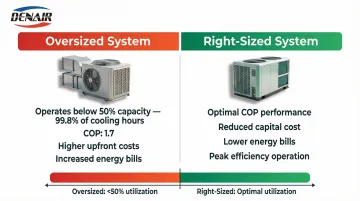
Equipment selection must also address a common VE pitfall: oversizing. A 2025 NREL study of NYC VRF systems found mechanical designers frequently oversize systems by 2–2.4x actual loads, causing them to operate below 50% capacity for 99.8% of cooling hours with a poor COP of just 1.7. Proper VE includes realistic load calculations to right-size equipment, reducing both upfront costs and long-term energy bills.
Ductwork and Distribution
Duct routing redesign can reduce both material and labor costs without affecting airflow performance. Strategies include:
- Using flexible duct where rigid was over-specified
- Optimizing branch layout to minimize material runs
- Adjusting duct sizing calculations based on actual CFM requirements
Ductwork typically accounts for 20-35% of total HVAC installed cost. Shop prefabrication increases labor productivity by 15-33% compared to field fabrication. Shifting ductwork assembly off-site cuts expensive on-site hours, staging time, and material waste.
Controls and Building Automation
Building automation system (BAS) specifications are frequently over-engineered for smaller commercial spaces. VE identifies right-sized control systems that meet code and provide the functionality the building actually needs. Three common BAS strategies vary significantly in cost and return:
| BAS Strategy | Cost per Sq. Ft. | Payback Period |
|---|---|---|
| Traditional hardware/software retrofit | $4.00–$8.00 | 6–10 years |
| Software-only upgrade | $0.65–$1.00 | 2–8 years |
| Automated System Optimization (ASO) | $0.15–$0.20 | 6–18 months |
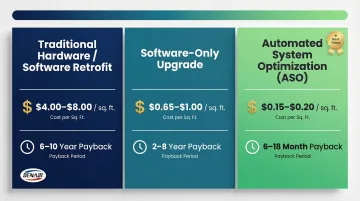
For small-to-midsize commercial buildings, ASO software overlays based on ASHRAE Guideline 36 achieve 15-30% energy savings at a fraction of traditional BAS costs.
Across all three categories—equipment, ductwork, and controls—the savings compound. Denair HVAC's dedicated estimator process documents every alternate and scope breakdown at bid stage, which is how clients have saved over $186,000 on commercial HVAC installations in a recent six-month period.
The HVAC Value Engineering Process: Step by Step
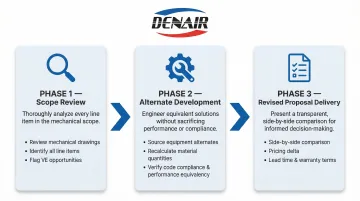
Phase 1: Scope Review The VE team receives the original mechanical drawings and specifications, identifies every line item, and flags components where alternatives exist without compromising design intent — covering equipment schedules, ductwork layouts, control sequences, and installation specifications.
Phase 2: Alternate Development The estimator sources equipment alternates, recalculates material quantities under revised routing, and documents performance equivalency for each substitution. Each alternate is verified against the original design for:
- BTU capacity and efficiency ratings
- Airflow specifications and duct sizing
- NYC code compliance and manufacturer warranty terms
Phase 3: Revised Proposal Delivery The client receives a side-by-side comparison of the original spec vs. each VE alternate, including pricing delta, lead time differences, and code/warranty considerations. Supporting documentation for every alternate includes:
- Manufacturer cut sheets and performance data
- Pricing breakdown with exact cost delta
- Lead time and warranty terms
How to Choose the Right HVAC Value Engineering Partner in Manhattan
The most important criteria for a VE partner in Manhattan is access to multiple equipment manufacturers (not loyalty to one brand), deep familiarity with NYC DOB requirements, and a track record of documented savings on comparable commercial projects.
Fixed-price proposals and warranty coverage are the two terms that separate serious VE contractors from budget vendors. A contractor who cannot stand behind alternate equipment selections with an extended warranty is transferring risk back to the building owner. Denair HVAC offers up to a 10-year manufacturer's warranty on new equipment and backs proposals with fixed pricing — unintended cost overruns are absorbed at their own expense.
Vetting Checklist for HVAC VE Contractors:
- Does the contractor provide written alternate submittals with performance data?
- Do they carry required NYC DOB licenses (Master Plumber, FDNY Q-01 Refrigerating System Engineer certificates)?
- Can they demonstrate prior VE savings on similar project types with documented case studies?
- Do they understand NYC-specific code requirements (Local Law 97, noise ordinances, zoning setbacks)?
That last point on licensing deserves extra scrutiny. NYC has no unified "HVAC Contractor" license — commercial work instead requires a complex matrix of Master Plumbers, Oil Burner Installers, and FDNY certificates that varies by system type. Vet every contractor for the specific credentials required for your VE-proposed system, not just their general business license.
Frequently Asked Questions
What is the difference between value engineering and cutting corners on HVAC?
Value engineering replaces equipment or methods with code-compliant, performance-equivalent alternatives. The outcome for occupants and building performance is identical—only the cost is reduced. Cutting corners sacrifices performance, reliability, or code compliance to reduce price.
How much can HVAC value engineering save on a Manhattan commercial project?
Savings typically range from 15-35% of the HVAC budget depending on project size and scope. On a $300,000 HVAC installation, this translates to $45,000-$105,000 in capital freed for other priorities. Denair has documented $186,000 in savings over six months across multiple commercial projects in Manhattan.
Does value engineering affect system warranties or NYC code compliance?
Legitimate VE uses manufacturer-approved alternates that carry full warranties and must still pass DOB review and inspections. A qualified contractor documents all substitutions for the permit record through TR1 Special Inspection forms and updated Schedule B filings.
When should value engineering be introduced in a construction project?
VE is most effective during the pre-construction/estimating phase before permits are filed. Applying it after construction begins limits options and may incur redesign costs, PAA fees, and schedule delays.
What types of commercial buildings benefit most from HVAC value engineering in Manhattan?
Office buildouts, retail fit-outs, multi-family residential, medical offices, and hospitality spaces are strong candidates—essentially any project where HVAC is a significant cost line. Buildings approaching Local Law 97 emission thresholds benefit especially, since VE can incorporate high-efficiency electric equipment that reduces both capital cost and long-term penalties.
Does HVAC value engineering work for both new construction and system replacements?
Yes, VE applies to both. For replacements, VE evaluates whether the specified unit is the most cost-effective option given existing infrastructure constraints, current NYC energy code, and available opportunities in controls upgrades or duct modifications.