The challenge is particularly acute for Manhattan's aging building stock. Seventy percent of large-building square footage in NYC relies on legacy central steam heating systems, which are highly inefficient and difficult to retrofit. These fossil-fuel-dependent systems generate disproportionate carbon emissions under LL97's formula, pushing many buildings toward penalty territory.
This guide covers what LL97 requires, how HVAC systems directly affect a building's carbon number, which upgrades move the needle most, what the penalties look like, and where to find financial help.
Key Takeaways
- LL97 requires NYC buildings over 25,000 sq ft to meet annual carbon emissions limits starting in 2024, with reports due May 1, 2025
- HVAC systems account for 42% of commercial building energy use and are the primary driver of carbon emissions under LL97
- Heat pump electrification, BAS upgrades, and preventive maintenance are the most impactful compliance strategies
- Penalties reach $268 per metric ton of CO₂e over the limit — a 100,000 sq ft office building could face $146,596 annually by 2030
- Con Edison, NYSERDA, and federal IRA incentives can cover 30–50% of upgrade costs
What Is Local Law 97 and Who Does It Apply to in Manhattan?
Local Law 97, enacted as part of the 2019 Climate Mobilization Act, is designed to cut NYC's building emissions 40% by 2030 and 80% by 2050 relative to 2005 levels. The law is already in its first compliance period (2024–2029), meaning Manhattan building owners must act now, not later.
Most large Manhattan properties fall under LL97's scope. Here's how the thresholds break down:
Coverage Thresholds:
LL97 applies to approximately 50,000 properties citywide, covering:
- Any single building over 25,000 gross square feet
- Two or more buildings on the same tax lot totaling over 50,000 gross square feet
- Multiple buildings under the same condo board exceeding 50,000 gross square feet collectively
That threshold sweeps in the majority of Manhattan's office, retail, multifamily, and mixed-use buildings.
Main Exemptions:
Certain properties have alternative compliance pathways or exemptions:
- NYC Housing Authority (NYCHA) buildings
- Houses of worship
- City-owned buildings
- Rent-regulated housing (where more than 35% of units are rent-regulated)
- Industrial facilities for power/steam generation
- HDFC properties
Building owners can confirm their status using the NYC Energy & Water Performance Map or by consulting a licensed mechanical contractor familiar with LL97 reporting requirements.
Why HVAC Systems Are the Key Variable in LL97 Compliance
LL97 measures compliance through a strict mathematical formula: Annual GHG Emissions ≤ GHG Emissions Limit. Annual emissions are expressed in metric tons of CO₂ equivalent (tCO₂e) per square foot, with limits varying by building occupancy type.
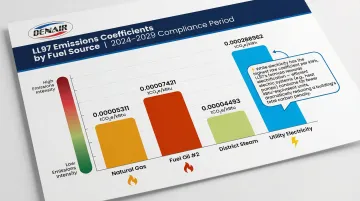
Emissions are calculated based on the fuel types a building consumes, not just how much energy it uses overall. Each fuel carries a different emissions factor:
| Fuel Source | Emissions Coefficient (2024–2029) |
|---|---|
| Natural Gas | 0.00005311 tCO₂e / kBtu |
| Fuel Oil #2 | 0.00007421 tCO₂e / kBtu |
| District Steam | 0.00004493 tCO₂e / kBtu |
| Utility Electricity | 0.000288962 tCO₂e / kWh |
The HVAC-to-Emissions Connection
According to the U.S. Energy Information Administration, space heating accounts for approximately 32% of commercial building energy use, with ventilation adding another 10%. Because Manhattan buildings heavily rely on natural gas boilers and steam heating — which carry high emissions factors — their HVAC systems generate an outsized portion of their total carbon footprint under LL97's formula.
Natural gas accounts for nearly 48% of all energy used in NYC buildings, and 70% of large-building square footage relies on legacy central steam systems. These 1-pipe steam configurations use 13% more energy on average than other heating systems and are overwhelmingly common in pre-war buildings.
The Manhattan-Specific Challenge
A large portion of the borough's building stock consists of pre-war high-rises and older mid-century buildings with legacy steam or oil-fired heating systems, limited mechanical room space, and aging equipment. These properties are more likely to exceed the 2024–2029 emissions thresholds than newer construction.
Buildings running on electric-powered HVAC face a lower emissions penalty than those on gas or oil, because LL97 assigns different emissions factors to each fuel type. That's why electrification — shifting from fossil-fuel heating to electric heat pumps — is the most impactful long-term strategy for many Manhattan properties.
Occupancy Types Most at Risk in Manhattan
The fuel-type penalty hits certain property categories harder than others. While 92% of large NYC buildings meet the initial 2024–2029 limits, only 43% are on track to meet the stringent 2030–2034 caps — a sharp drop that signals where the real compliance pressure is building.
| Occupancy Type | % Meeting 2024 Limits | % Meeting 2030 Limits |
|---|---|---|
| Office Buildings | 93-94% | 47-50% |
| Multifamily Buildings | 93-94% | 46-49% |
Building categories most likely to exceed LL97 limits include:
- Office buildings — High plug loads plus HVAC demand
- Large multifamily residential — Heavy reliance on steam heat in older buildings
- Hospitality — 24/7 HVAC operation for guest comfort
- Healthcare facilities — Continuous operation with strict temperature/ventilation requirements
- Mixed-use properties — Combined residential and commercial loads
For these building types, maintaining the status quo through 2030 is no longer a neutral decision — it's a path to recurring annual fines. The next question is which HVAC upgrades move the compliance needle most efficiently.
HVAC Upgrades That Move the Needle on LL97 Compliance
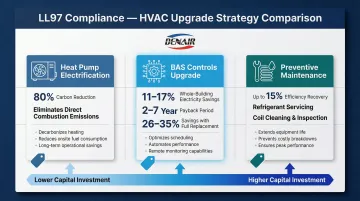
The most impactful LL97 compliance move for gas- or steam-heated Manhattan buildings is transitioning to electric heat pumps — including Variable Refrigerant Flow (VRF) systems, water-source heat pumps, and high-efficiency packaged terminal heat pumps (PTHP). These systems eliminate direct combustion emissions entirely and reduce a building's LL97 carbon number significantly.
The emissions reductions are substantial:
- Electrifying space heating in NYC multifamily buildings cuts carbon emissions by at least 80%; water heating electrification reduces them by 56%
- VRF systems deliver an estimated 26% in site energy savings and an 18% reduction in greenhouse gas emissions
For buildings ready to make the switch, Denair HVAC designs and installs heat pump systems across Manhattan's commercial and multifamily properties. Their Samsung VRF experience includes the DVM Chiller (scalable to 320 tons) and the DVM S ECO, which targets apartments and compact commercial offices with 20% better heating performance.
Building Automation System (BAS) Upgrades
Smart HVAC controls offer a lower-capital-cost option for buildings close to their emissions limit. Optimizing scheduling, setback temperatures, and equipment run times can measurably reduce energy consumption and emissions without replacing the entire system.
Field demonstrations show that implementing ASHRAE Guideline 36 high-performance control sequences achieves 11–17% whole-building electricity savings with a 2-to-7-year simple payback. Full control system replacements can yield 26–35% electricity savings.
HVAC Commissioning and Preventive Maintenance
A poorly tuned system — dirty coils, misaligned controls, refrigerant leaks, degraded insulation on pipes — burns significantly more fuel than a properly maintained one, inflating both energy bills and the building's reported CO₂e.
Key maintenance impacts:
- A 25% refrigerant undercharge reduces efficiency by 15%
- Dirty coils increase fan power draw by up to 10%
Regular professional commissioning can close the gap before costly equipment swaps are required. Denair HVAC's preventive maintenance programs cover:
- Leak detection and refrigerant level management
- Condenser and coil cleaning
- Compressor oil maintenance and heat exchanger inspection
- Filter replacement and controls calibration
Envelope and Duct Improvements
Sealing ductwork, upgrading insulation, and addressing building envelope weaknesses reduce how hard HVAC systems work, which lowers energy consumption and emissions directly at the source.
How to Decide Which HVAC Upgrades to Prioritize First
The right starting point is a professional energy audit combined with an LL97 emissions gap analysis. Building owners should:
- Calculate current tCO₂e/sq ft against their building type's compliance threshold
- Model which upgrades close the most gap per dollar invested
- Prioritize high-ROI interventions like controls upgrades or equipment tune-ups before committing capital to full system replacements, unless the emissions gap requires it
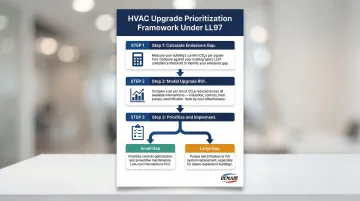
For buildings that are close to their emissions limit but not far over it, BAS upgrades and preventive maintenance offer rapid payback. For buildings with large emissions gaps or relying on legacy steam systems, heat pump electrification becomes essential.
LL97 Compliance Deadlines, Reporting Requirements, and Penalties
LL97 enforces compliance through three progressively tightening periods:
Compliance Periods:
- 2024–2029 (Phase 1): The least restrictive phase — 92% of NYC buildings currently meet limits
- 2030–2034 (Phase 2): Significantly stricter — only 43% of buildings are on track to meet limits
- 2035–2050: Continuing tightening toward full decarbonization
Building owners who delay action on HVAC upgrades now will face far more disruptive and expensive corrections under Phase 2.
Annual Reporting Requirement:
Starting May 1, 2025, building owners must submit a certified GHG emissions report to the NYC Department of Buildings each year, signed by a Registered Design Professional, documenting the building's actual emissions against its annual limit.
Penalty Structure:
- $268 per metric ton of CO₂e over the building's annual limit
- $0.50 per square foot per month for failure to submit the annual report
- Up to $500,000 plus potential imprisonment for false reporting
Illustrative Fine Calculation:
Consider a 100,000 sq ft Manhattan office building operating at 0.01000 tCO₂e/sf (1,000 tCO₂e annually). The emissions limits for Business Group B (Office) are 0.00846 tCO₂e/sf for 2024–2029, dropping to 0.00453 tCO₂e/sf for 2030–2034.
| Compliance Period | Limit (tCO₂e/sf) | Excess Emissions | Annual Fine |
|---|---|---|---|
| 2024–2029 | 0.00846 | 154 tCO₂e | $41,272 |
| 2030–2034 | 0.00453 | 547 tCO₂e | $146,596 |
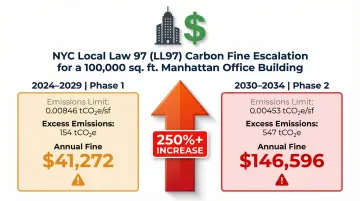
The financial penalty for the exact same building operations will increase by over 250% when the 2030 limits take effect. Buildings that haven't upgraded HVAC systems by then won't just face larger fines — they'll be competing for contractors and equipment during a city-wide compliance crunch.
Financial Incentives That Help Offset HVAC Upgrade Costs
Building owners can offset the capital expenditures required for HVAC decarbonization by stacking utility rebates, federal tax deductions, and specialized financing. The table below shows the five main programs available to NYC building owners in 2025:
| Program | Type | Benefit |
|---|---|---|
| NYC Accelerator | Free advisory + financing navigation | 1-on-1 guidance, pre-vetted contractors, PACE referrals |
| Con Edison C&I Electrification | Cash rebate | $70–$200/MMBtu depending on project scope |
| NYSERDA NYS Clean Heat | Rebate + contractor network | Cold-climate heat pump rebates for commercial/multifamily |
| IRS Section 179D | Federal tax deduction | Up to $5.81/sq ft for 50%+ energy savings (2025 rate) |
| NYC C-PACE | Property-assessed financing | 100% upfront, long-term fixed-rate repaid via property tax bill |
NYC Accelerator Program
The NYC Accelerator is a free city resource connecting building owners with advisors, pre-vetted contractors, and technical assistance. It provides 1-on-1 expert guidance, project verification, and financing navigation, making it the natural first call for owners mapping a compliance path under Local Law 97.
Con Edison Rebates
The Commercial and Industrial Building Electrification program pays cash rebates based on load type:
- $120/MMBtu for full load electrification
- $70/MMBtu for phased load electrification
- $200/MMBtu for domestic hot water (DHW) electrification
Federal and Financing Options
The NYS Clean Heat program (NYSERDA) adds rebates and a vetted contractor network for cold-climate heat pump installations in commercial and multifamily buildings.
Section 179D tax deductions offer up to $5.81/sq ft in 2025 for buildings achieving 50% energy savings, subject to prevailing wage requirements.
For owners managing upfront capital, NYC C-PACE financing spreads the full project cost over time through the property tax bill, with no money down and fixed long-term rates.
The most effective strategy combines all three layers: Con Edison rebates reduce gross project cost, 179D captures a federal tax offset, and C-PACE finances whatever remains, keeping cash reserves intact.
Frequently Asked Questions
What is Local Law 97 compliance in NYC?
LL97 requires NYC buildings over 25,000 sq ft to stay within annual greenhouse gas emissions limits based on occupancy type and submit certified annual reports starting May 1, 2025 — with fines for exceeding those limits. It's part of the city's Climate Mobilization Act, which targets a 40% reduction in building emissions by 2030.
What is the penalty for Local Law 97 in NYC?
Buildings face three penalty tiers: $268 per metric ton of CO₂e over the annual emissions limit, $0.50 per square foot per month for failure to submit the annual GHG report, and up to $500,000 (plus possible imprisonment) for false reporting.
Does Local Law 97 apply to all buildings?
LL97 covers buildings over 25,000 gross square feet and certain multi-building lots. Key exemptions include city-owned buildings, houses of worship, NYCHA housing, rent-regulated properties under specific conditions, and industrial power-generation facilities.
Does Local Law 97 apply to residential buildings?
Yes, multifamily residential buildings over 25,000 square feet are covered — including co-ops and condos. However, NYCHA housing, certain rent-regulated buildings, and small residential buildings of 3 stories or fewer without central HVAC have alternative compliance pathways or exemptions.
What is the difference between Local Law 97 and Local Law 84?
LL84 is NYC's benchmarking law requiring large buildings to track and report annual energy and water use data. LL97 goes further by setting mandatory emissions limits and imposing fines if those limits are exceeded — benchmarking under LL84 provides the foundation data that feeds into LL97 compliance.
What is the difference between Local Law 87 and Local Law 97?
LL97 sets binding annual carbon emissions limits backed by financial penalties. LL87 supports that goal by requiring buildings over 50,000 sq ft to conduct periodic energy audits and retro-commissioning every ten years — identifying where improvements are needed. LL87 points to the problems; LL97 requires you to fix them.