
HVAC value engineering solves this exact problem. It's a systematic process that identifies equipment, layout, and design alternatives that deliver identical performance at significantly lower cost—typically 15–35% savings on mechanical budgets. For Long Island City's high-cost commercial environment, where construction costs hit $534 per square foot and costs escalated 4.03% year-over-year in Q4 2025, value engineering isn't optional—it's essential.
Key Takeaways
- Value engineering reviews your HVAC design to find lower-cost alternatives that deliver equivalent performance before installation begins
- In Long Island City's high-cost commercial market, mechanical budget optimization directly impacts project feasibility
- Start during design development — equipment substitution, layout optimization, and vendor sourcing are where savings are found
- Contractors with direct manufacturer relationships can cut total HVAC budgets by 15–35%
What Is HVAC Value Engineering?
Value engineering (VE) in HVAC is a structured, function-based methodology that identifies alternative equipment, materials, or design approaches delivering equivalent performance at lower cost. According to SAVE International, the global standards body for value methodology, VE is defined as "a systematic process used by a multidisciplinary team to improve the value of a project through the analysis of functions." The formula is simple: Value = Function Performance / Resources.
This is not cost-cutting. Cost-cutting slashes scope arbitrarily — value engineering maintains performance standards, code compliance, warranty terms, and system lifespan while targeting inefficiency in specification and procurement.
What VE Typically Evaluates
- Equipment brand and model equivalents (RTUs, split systems, VRF units, fan coils, VAV boxes)
- Duct layout efficiency and material selection (round vs. rectangular, flexible vs. rigid)
- Zoning configurations and control system tiers
- Refrigerant type and piping materials
- Installation methodology and labor efficiency
When VE Delivers Maximum Impact
Value engineering works best during design development or pre-construction — before procurement locks in. Late-stage VE can still yield savings, but alternatives narrow once equipment orders are placed.
The Scale of Opportunity
Mechanical systems are among the largest line items in commercial construction budgets. Denair's commercial clients have saved over $186,000 on HVAC installation in a recent six-month period — a direct result of applying VE during the pre-procurement phase, where the most impactful substitutions are still on the table.
Why Long Island City Projects Need HVAC Value Engineering
The LIC Commercial Landscape
Long Island City is undergoing rapid mixed-use development across high-rise residential towers, office-to-residential conversions, retail buildouts, and medical facilities. The NYC Department of City Planning's OneLIC Neighborhood Plan spans 160 city blocks over 1.31 square miles.
The scale of new construction tells the story: according to REBNY's Q3 2025 pipeline report, Queens led NYC with 174 new building filings encompassing over 4,300 units.
Every one of these projects requires substantial HVAC scope—and every dollar counts.
Specific Cost Pressures in LIC and NYC
Construction Cost Reality:
- NYC commercial construction costs: $534 per square foot—the highest globally
- 4.03% year-over-year cost escalation in Q4 2025
- HVAC equipment faces historic backlogs and price increases
Regulatory Complexity:
- NYC building codes and permit requirements
- DOB inspection protocols
- Local Law 97 carbon penalties of $268 per ton of CO2 equivalent for buildings exceeding emissions caps
- Compressed construction timelines amplifying cost recovery difficulty
Breaking the Single-Manufacturer Monopoly
Many LIC projects receive specifications written around a single manufacturer or system type. This inflates cost by restricting competition. Federal Acquisition Regulation (FAR) 11.104 explicitly requires "brand name or equal" purchase descriptions to allow contractors to offer alternative products meeting salient characteristics.
Value engineering opens bidding to equivalent alternatives, often 15–30% less expensive, without compromising performance.
Local Law 97: The Carbon Penalty Threat
For buildings over 25,000 gross square feet, Local Law 97 changes HVAC economics directly:
- 2024–2029: Initial carbon caps in effect—9% of properties currently exceed limits
- 2030–2034: Stricter limits enforced—57% of properties currently emit more than their 2030 cap
- Penalty: $268 per ton of CO2 equivalent over the limit
Value engineering that selects cheaper, fossil-fuel-reliant equipment will cost owners exponentially more in LL97 fines. Smart VE balances upfront cost with long-term compliance.
How the HVAC Value Engineering Process Works
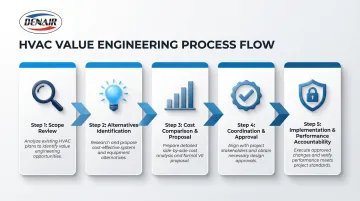
Step 1 — Scope Review
The process begins with a thorough review of existing HVAC specifications or design drawings. The contractor examines system requirements, load calculations, zoning configurations, and performance targets to understand what the system must accomplish.
Step 2 — Alternatives Identification
A qualified estimator or application engineer identifies equipment alternatives from vetted manufacturers that meet or exceed specified performance. This covers:
- Units (RTUs, split systems, VRF, fan coils, VAV boxes)
- Controls and thermostats
- Diffusers and grilles
- Ductwork materials and configurations
- Piping materials
Every alternative must deliver equivalent function — performance is never traded away for price.
Step 3 — Cost Comparison and Proposal
The contractor prepares a side-by-side comparison showing original vs. VE scope with:
- Detailed pricing breakdowns
- Lead times and delivery schedules
- Warranty terms
- Any trade-offs or performance differences
Step 4 — Coordination and Approval
The MEP engineer of record must review VE proposals, and where applicable, the owner or building department must sign off as well. Denair's team handles submittal preparation and coordinates approvals to avoid delays.
NYC DOB Consideration: Under DOB NOW: Build, only one Post Approval Amendment (PAA) can be open at a time. Consolidating all VE changes into a single PAA prevents administrative gridlock.
Step 5 — Implementation with Performance Accountability
Once approved, the VE scope is locked into a fixed-price proposal so savings are protected and no unintended cost creep occurs post-award. Denair HVAC's Fixed Proposal Pricing model, for example, guarantees that all unintended costs are compensated at their own expense—ensuring value engineering savings flow directly to the client.
Key HVAC Systems and Areas Where Value Engineering Cuts Costs
Equipment Substitution
Rooftop units, split systems, VRF systems, fan coil units, and VAV boxes often have direct equivalents across manufacturer lines. Proper substitution here typically yields the largest dollar savings on a project—often 15–30% depending on the specified brand vs. the alternative.
Using "brand name or equal" specifications allows contractors to source the most cost-effective equipment that meets the engineer's performance criteria without sacrificing quality or warranty coverage.
Duct and Distribution Optimization
Where equipment substitution targets unit costs, ductwork geometry is one of the highest-yield areas for value engineering on labor. According to SMACNA's Round Industrial Duct Construction Standards, round spiral ductwork offers significant labor and performance advantages over rectangular duct:
| Duct Type | Structural Integrity | Installation Efficiency | Leakage Performance |
|---|---|---|---|
| Round Spiral | Inherently stronger; D/t ratio up to 1800 | Manufactured in 10-20 ft lengths; fewer joints | Spiral seams exempt from sealant; virtually zero leakage |
| Rectangular | Weaker flat surfaces; buckling risk | Manufactured in 4-6 ft lengths; 2-3x more joints | Higher leakage risk at joints; requires extensive sealing |
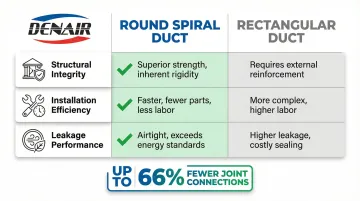
Converting rectangular ductwork to round spiral reduces joint connections by up to 66%, cutting labor costs while improving system airtightness.
Controls and BMS Integration
Specifying a mid-tier controls package compatible with existing building systems often delivers the same operational outcomes as premium systems at substantially lower cost. ASHRAE Guideline 36 (High-Performance Sequences of Operation) defines best-in-class control sequences—meaning a mid-tier DDC controller running Guideline 36 sequences can match the performance of a premium proprietary system without the markup.
Field demonstrations show:
- Software-only retrofits (updating sequences on mid-tier DDC systems): approximately $0.65 per square foot
- Full hardware and software retrofits: approximately $6.40 per square foot
By specifying ASHRAE Guideline 36 sequences on open-protocol BACnet controllers, owners achieve premium analytics and Local Law 97-compliant efficiency without the premium hardware markup—for LIC commercial projects, that gap between $0.65 and $6.40 per square foot is often where the most actionable budget recovery lives.
What to Look for in an HVAC Value Engineering Partner in Long Island City
Local Market Knowledge
A VE partner needs to understand NYC code requirements, DOB processes, Local Law 97 implications, and the specific building typologies common in Long Island City. Without that grounding, a contractor can't accurately price VE alternatives or move permits through DOB without delays. Key areas of expertise to verify:
- NYC DOB licensing and permitting requirements
- Local Law 97 modeling and compliance pathways
- ESPM (EPA ENERGY STAR Portfolio Manager) property type classifications
- Post Approval Amendment (PAA) coordination
Manufacturer Relationships and In-House Estimating
Local expertise sets the regulatory foundation — but the ability to act on VE opportunities depends on supplier access and estimating speed. Contractors with direct manufacturer relationships reach pricing tiers and technical support that generalist firms simply don't have. In-house estimating (not outsourced) means proposals come back faster and reflect the actual scope:
- Direct access to manufacturer technical support
- Volume pricing and preferential terms
- Faster turnaround on alternative equipment specs
- Detailed scope breakdowns and alternates
Track Record on Commercial Projects
Beyond credentials and relationships, look for documented results on commercial projects comparable in scale to yours. Denair HVAC's track record in the NYC market includes:
- Over 400 commercial projects completed across NYC
- $76M in project bids demonstrating capacity to handle large-scale scopes
- Clients saving over $186,000 on commercial HVAC installation in recent months through value engineering
- Inc. 5000 recognition as one of America's fastest-growing companies
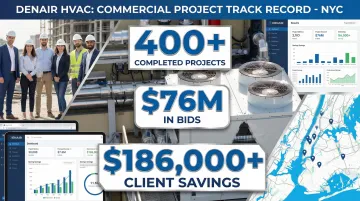
That volume of completed work — across office buildings, retail, medical, and multi-family properties — means proven systems for finding savings, processing DOB approvals, and holding to fixed-price commitments.
Frequently Asked Questions
What is value engineering in the construction industry?
Value engineering is a structured methodology used to analyze a project's functions and identify ways to achieve the same performance outcomes at lower cost. It applies across mechanical, structural, and other building systems — with the goal of matching performance and code requirements while reducing unnecessary spend.
What is an HVAC contractor?
An HVAC contractor is a licensed professional who designs, installs, maintains, and repairs heating, ventilation, and air conditioning systems. In value engineering contexts, a commercial HVAC contractor reviews specifications, proposes approved substitutions, and coordinates with MEP engineers and building departments to keep projects on budget without compromising compliance.
How much can HVAC value engineering save on a commercial project?
Savings vary by project scope and complexity, but commercial HVAC value engineering commonly reduces mechanical budgets by 15–35%. Larger projects with open specifications or single-manufacturer bias tend to see the greatest savings.
Does value engineering compromise the quality or longevity of an HVAC system?
Well-executed VE maintains equivalent performance standards, warranty terms, and code compliance. The target is over-specification and markup inefficiency — not equipment quality. You get the same function and lifespan at a lower price point.
When should HVAC value engineering be initiated on a Long Island City project?
VE is most effective during design development or pre-construction bidding. It can still reduce costs in early construction if equipment procurement hasn't been finalized — though options narrow once orders are placed. Denair HVAC can review your mechanical scope at either stage to identify where savings are available.