Queens presents a uniquely challenging environment for commercial HVAC work. The borough's dense mix of aging commercial buildings, high-rise multifamily complexes, and mixed-use retail corridors means that cookie-cutter equipment specifications often result in overspending on systems that don't match actual building loads. Add NYC's stringent building codes—including Local Law 97's aggressive carbon caps and $268-per-ton penalties—and the financial stakes have never been higher.
This article explains what HVAC value engineering actually means, how the process works step-by-step, what it can save on Queens projects, and what to look for when vetting a contractor who serves this market.
Key Takeaways
- HVAC value engineering delivers the same system performance at lower cost through smarter equipment selection, system redesign, and procurement — without sacrificing quality or code compliance.
- Queens commercial properties face specific cost pressures: aging infrastructure, dense layouts, limited rooftop access, and NYC code requirements including LL97 emissions limits.
- A qualified value engineering contractor reviews specs, proposes equal-performance alternatives, and locks in fixed pricing with no surprise costs.
- Well-executed HVAC value engineering can reduce project budgets by up to 35% while maintaining code compliance and long-term reliability.
What Is HVAC Value Engineering?
Value engineering in the HVAC context is a systematic, structured process of analyzing a project's mechanical scope to identify equipment, materials, or design alternatives that deliver equivalent performance at a lower cost—without compromising code compliance, comfort, or system longevity.
This is not cost-cutting. Cost-cutting typically reduces quality or scope. True value engineering, as defined by SMACNA, "identifies opportunities to remove unnecessary costs while assuring that quality, reliability, performance, and other critical factors will meet or exceed the customer's expectations."
The Three Primary Levers of HVAC Value Engineering
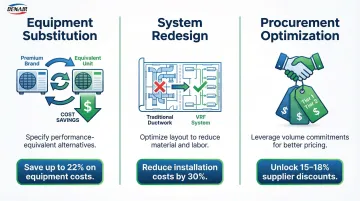
- Substitute equivalent equipment at lower cost — for example, swapping a $18,000 premium-brand rooftop unit (RTU) for a certified equivalent at $13,500 with identical cooling capacity, efficiency rating, and warranty terms.
- Redesign system layout or zoning to cut material and labor costs. In older Queens buildings with limited vertical shafts, this might mean switching from a central air handler to a Variable Refrigerant Flow (VRF) system that eliminates ductwork entirely and works around the building's structural limitations.
- Optimize procurement through manufacturer relationships and volume pricing — contractors with direct certifications access pricing tiers unavailable to smaller firms.
When Value Engineering Delivers Maximum Impact
Value engineering delivers the most impact when it begins during the design or pre-construction phase, while equipment selections and system layouts are still flexible. That said, experienced contractors can also apply it during bid review or mid-project when scope changes arise — identifying alternates in real time and protecting project margins without stopping the work.
The Role of the Estimator in Value Engineering
A skilled HVAC estimator doesn't just price what's specified — they actively scan the scope for alternates that hold performance while cutting cost. That analysis requires individual attention to every bid. In practice, this means:
- Detailed scope breakdowns that itemize every cost line
- Itemized alternates with clear performance comparisons
- Revision cycles that keep owners and GCs informed at each step
Denair HVAC's lead estimator, Farrukh Kasimov, has handled this work since 2010. Every bid receives a dedicated review — no templated pricing, no generic substitutions.
Why Queens Commercial Properties Have Unique HVAC Cost Pressures
Queens is a dense, diverse borough with a high concentration of older commercial buildings, mixed-use properties, and multifamily residential complexes. Much of this stock carries outdated HVAC infrastructure that complicates new installations and drives up project costs.
The Queens Building Landscape
Commercial real estate in Queens is concentrated in key economic corridors: Downtown Jamaica, Downtown Flushing, and Long Island City. A significant portion of this stock dates back to the 1930s and earlier. Across NYC, buildings over 50,000 square feet represent just 2% of the building stock but account for nearly half of all built square footage.
Retrofitting these older structures with modern HVAC systems creates three recurring obstacles:
- Limited electrical capacity: Older buildings often lack the electrical service required for modern high-efficiency equipment.
- Narrow shafts and risers: Existing outdoor air shafts and vertical risers may not accommodate larger-capacity modern units.
- Poor envelope interactions: Aging building envelopes with high infiltration rates undermine HVAC system performance.
NYC DOB Regulations and Local Law 97
NYC Department of Buildings regulations and permit requirements add layers of cost and complexity. Local Law 97 (LL97) imposes strict greenhouse gas emissions limits on buildings over 25,000 square feet starting in 2024, with limits becoming significantly more stringent in 2030.
Non-compliance carries real financial exposure:
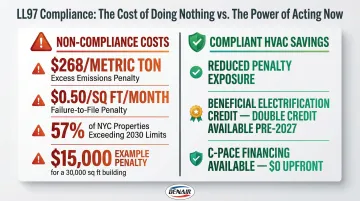
- Excess emissions penalty: $268 per metric ton of CO₂ equivalent above the annual limit
- Failure-to-file penalty: $0.50 per square foot, per month for missing the required emissions report
Currently, 57% of NYC properties emit more than their 2030 limits. For a 30,000 sq ft building that misses a single filing, that's $15,000 in penalties before any excess emissions are calculated. Selecting high-efficiency equipment during the design phase is one of the most direct ways to reduce that exposure.
Geographic and Property Diversity
Queens spans industrial corridors in Long Island City, dense retail strips in Flushing, and mixed-use blocks in Jamaica. Each zone has different load profiles, utility infrastructure, and occupancy patterns. Generic equipment specifications routinely miss these differences.
The result: at least 25% of all rooftop HVAC units are oversized, which drives up energy costs, causes short-cycling, accelerates equipment wear, and wastes capital that could be applied elsewhere in the project budget.
How HVAC Value Engineering Works: The Process Step by Step
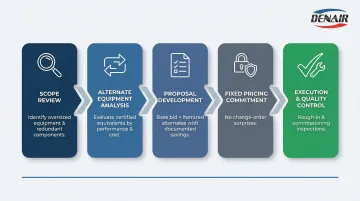
Effective value engineering follows a structured, repeatable process. Here's how it works in practice:
Step 1 — Scope Review and Opportunity Identification
The contractor reviews the original mechanical specifications, drawings, and equipment schedules to flag items where alternatives or design changes could yield cost savings without sacrificing performance. This includes:
- Identifying oversized equipment based on actual load calculations
- Spotting redundant or over-specified components
- Evaluating ductwork layouts for material efficiency
Step 2 — Alternate Equipment Analysis
Using established manufacturer relationships, the contractor identifies alternative equipment—different brand, model, or configuration—that meets or exceeds the original spec's performance requirements, efficiency ratings, and warranty terms.
For example, if the original spec calls for a 10-ton rooftop unit from a premium brand, the contractor might propose a certified equivalent from a different manufacturer that delivers the same cooling capacity, SEER rating, and 5-year compressor warranty. The price difference is often 20–30% lower.
Step 3 — Proposal Development with Alternates
Rather than submitting a single lump-sum bid, an experienced value engineering contractor provides a structured proposal that includes:
- Base bid priced to the original equipment and scope
- Itemized alternates listed separately so each option can be accepted or rejected individually
- Documented savings showing the exact cost reduction for each proposed change
This transparency gives the owner or general contractor full visibility to make informed decisions about which alternates to accept.
Step 4 — Fixed Pricing Commitment
Once alternates are accepted, all unintended costs that arise during execution are absorbed by the contractor—not passed back to the client. This fixed pricing model separates true value engineering contractors from those simply offering a low initial quote that balloons during construction.
Denair HVAC backs this with a fixed proposal pricing guarantee: any unforeseen installation costs are covered at the contractor's expense, with no change-order surprises passed to the client.
Step 5 — Execution and Quality Control
Value engineering savings are only realized if the installed system performs as designed. Dual quality control checkpoints are essential:
- Rough-in inspection confirms ductwork, piping, and equipment placement match the approved plans before walls close in
- Commissioning inspection verifies the alternate equipment operates to spec and delivers the promised performance under real load conditions
Both checkpoints are documented, giving owners a clear record that the installed system meets the original design intent.
The Real Financial Benefits of HVAC Value Engineering for Queens Projects
The financial case for value engineering is compelling. Denair HVAC's clients have collectively saved over $186,000 on commercial HVAC installations in just the last 6 months through value engineering. Individual project budgets can be reduced by up to 35% depending on scope and equipment selections.
Upfront Savings
Upfront savings matter—but initial construction costs represent only ~2% of a building's 30-year total cost of ownership. The remaining 98% comes from operations, maintenance, and personnel costs.
Long-Term Operating Cost Reductions
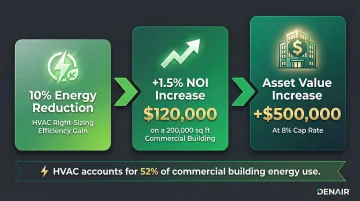
HVAC accounts for 52% of all commercial building energy consumption—space heating at 32%, ventilation at 11%, and cooling at 9%. In NYC multifamily buildings, space heating and hot water alone represent about 70% of site energy use.
That makes HVAC the single highest-leverage target for operating cost reduction. Energy is the largest operating expense in commercial office buildings—roughly one-third of typical budgets. The downstream impact of right-sizing equipment compounds quickly:
- A 10% drop in energy use lifts Net Operating Income (NOI) by 1.5%
- In a 200,000 sq ft office building, that translates to $120,000 in additional NOI
- At an 8% cap rate, the same efficiency gain adds $500,000 to asset value
Warranty and Lifecycle Cost Advantages
Standard commercial HVAC warranties cover parts for 1 year and compressors for 5 years—but exclude labor, refrigerant, and freight. Extended warranties of up to 10 years are available on new equipment when installed by certified contractors, cutting total cost of ownership compared to standard 1-3 year coverage.
For example, Mitsubishi's City Multi VRF systems offer a 10-year extended warranty when installed by a certified "Diamond Contractor", doubling the parts and compressor warranty lifecycle and reducing 10-year maintenance risk.
LL97 Compliance Credits
New LL97 rules offer a "Beneficial Electrification Credit" that heavily rewards early heat pump adoption before 2027. Equipment installed before 2027 receives double the credit, which can be applied to mitigate penalties up until 2036. Paired with NYC Accelerator's C-PACE financing—which covers 100% of hard and soft costs at fixed rates—compliance mandates become cash-flow-positive asset upgrades.
How to Choose an HVAC Value Engineering Contractor in Queens, NY
Not all contractors are equipped to deliver true value engineering. Here are the key criteria to evaluate:
Proven Local Commercial Experience
Look for a contractor with a documented portfolio of commercial HVAC projects in Queens and the broader NYC metro area. Check whether they have worked on building types similar to yours: retail, office, multifamily, medical, or industrial.
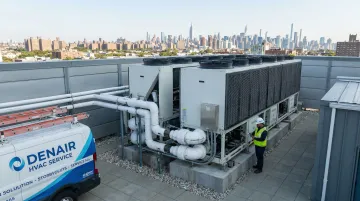
Denair HVAC has over 19 years of experience and has completed 400+ projects across NYC boroughs, including banking facilities in Flushing and commercial installations throughout Queens. In 2019, the company was recognized by Inc. 5000 as one of America's fastest-growing companies.
Manufacturer Relationships and Certifications
A contractor with direct relationships with major HVAC manufacturers—including certified training—can access better pricing, faster equipment delivery, and stronger warranty support. That access is what makes equipment substitution in value engineering actually work.
Denair HVAC is trained and certified by major manufacturers, which supports preferential pricing, extended warranty programs, and a 10-year equipment warranty option that passes real savings to clients.
Transparent, Itemized Bidding Process
Avoid contractors who provide a single lump-sum number. Look for those who offer:
- Detailed scope breakdowns
- Alternate options with itemized pricing
- Fixed-price guarantees so you know exactly what you're getting and what it costs
Denair's estimating process provides individual attention to every bid, with scope breakdowns, alternates, and revisions that give full transparency into where costs can be optimized.
Licensing, Compliance, and Insurance
Verify that the contractor holds a registered Mechanical/HVAC contractor license, carries proper insurance, and has documented OSHA certifications—especially for complex commercial projects in NYC that involve scaffolding, rooftop equipment, or occupied buildings.
NYC commercial HVAC installations carry specific regulatory requirements:
- DOB NOW filing: Installations must be filed in the DOB NOW: Build portal under the Mechanical Systems (MS) work type, and NYC only issues permits to a Registered General Contractor with a place of business in NYC and active insurance.
- TR1 Inspections: Mandatory TR1 Special and Progress Inspections are required for commercial HVAC projects, including verification of conformance with approved construction documents and NYC Energy Conservation Code requirements.
Denair HVAC holds OSHA 40-hour and scaffolding certifications, and operates as a registered Mechanical/HVAC contractor in compliance with NYC DOB requirements.
Frequently Asked Questions
Is value engineering cost cutting?
No. Value engineering is a structured process of finding alternative equipment or design approaches that deliver the same performance at a lower price, without reducing system quality, reliability, or code compliance. It's about smarter procurement and design, not compromising standards.
How to choose an HVAC contractor?
Verify local commercial experience, proper licensing and insurance, manufacturer certifications, and documented warranty terms on both labor and equipment. Look for contractors who offer fixed-cost proposals—so any unintended costs come out of their pocket, not yours. Ask for references from similar building types in your area.
What is HVAC value engineering?
HVAC value engineering reviews a project's full mechanical scope to find equipment substitutions, design efficiencies, or procurement strategies that cut cost without sacrificing performance, efficiency ratings, or code compliance.
How much can value engineering save on a commercial HVAC project?
Savings vary by project size and scope, but well-executed HVAC value engineering can reduce project budgets by up to 35%. On larger commercial installations, real-world results can exceed $186,000 in documented savings.
Does value engineering affect HVAC system quality or performance?
When done correctly, value engineering does not reduce quality. Alternate equipment must meet or exceed the original specification's performance, efficiency ratings, and warranty terms before it is proposed as a substitute.
Is HVAC value engineering suitable for commercial projects in Queens, NY?
Yes. Queens commercial properties are strong candidates, given the borough's mix of older buildings, NYC energy code requirements, and diverse property types. A local contractor's hands-on knowledge of the building stock and code requirements translates directly into practical, compliant savings.