Introduction
Brooklyn building owners, property managers, and general contractors face a stubborn reality: commercial HVAC consistently ranks as one of the largest line items in any construction or renovation budget. According to RSMeans 2024 Project Cost data, mechanical systems consume 8% to 18% of total project costs in standard commercial buildings—yet most projects never question whether the specified system is actually the most cost-effective option that meets performance requirements.
HVAC value engineering is a systematic process of analyzing a project's mechanical scope to identify alternative equipment, system configurations, or installation approaches that deliver equal or better performance at a lower cost. It's not corner-cutting—it's disciplined substitution with documented performance requirements.
With 63% of NYC buildings projected to face $268-per-ton carbon penalties under Local Law 97 by 2030, the financial case for value engineering is no longer optional.
This guide covers the value engineering process, Brooklyn-specific savings opportunities, and what separates contractors who can document results from those who can't.
TLDR:
- Mechanical systems account for 8-18% of commercial project costs—making HVAC the highest-impact target for value engineering
- Brooklyn's 87% pre-war building stock creates unique constraints that inflate installation costs without strategic planning
- Equipment substitution, system rightsizing, and controls simplification routinely save 20-35% on HVAC budgets
- Denair HVAC clients saved over $186,000 in six months through value-engineered equipment alternatives
What Is HVAC Value Engineering?
HVAC value engineering (VE) is a systematic review of function versus cost, seeking alternatives that preserve or improve performance while reducing budget. The goal is a structured methodology that evaluates every specification against its actual performance contribution — not a license to cut corners or swap in inferior equipment.
Value Engineering vs. Cheap Substitution
True VE replaces a specified product with a code-compliant equivalent from a different manufacturer or product line, or redesigns a system configuration to eliminate unnecessary complexity. Quality is maintained; only the cost premium is removed.
Cheap substitution downgrades performance by using lower-efficiency equipment, thinner ductwork, or unrated components that create compliance risk and operational failure. Federal procurement guidelines (FAR 11.104) explicitly favor "performance specifications" over proprietary brand names to encourage competitive pricing without sacrificing quality.
Who Initiates Value Engineering?
VE proposals can come from multiple stakeholders at different project stages:
- General contractors reviewing bid packages for scope optimization
- Property owners seeking budget relief before construction starts
- Mechanical contractors identifying system redesign opportunities during design development
- Any party flagging change-order risk once a project is already underway
The earlier VE enters the process, the greater the savings — ideally before equipment is ordered and installation sequences are locked.
The Financial Stake
Mechanical costs range from $12.40 to $94.50 per square foot depending on building type, with healthcare facilities commanding the highest percentage (17.85% of total project cost) and office buildings averaging 8.15%. On a $2M mechanical scope, a 10% reduction through VE saves $200,000 — and contractors like Denair HVAC have helped Brooklyn clients recover up to 35% of their HVAC budget through systematic value engineering.
The HVAC Value Engineering Process: Step by Step
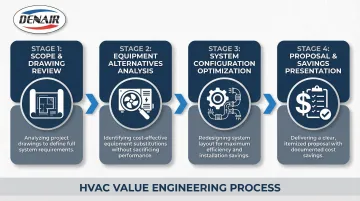
Scope and Drawing Review
The process begins with a thorough review of mechanical drawings, specifications, and equipment schedules to understand exactly what has been designed—brand, model, capacity, efficiency ratings, and installation requirements.
This step often surfaces "over-specification"—situations where the original design calls for premium-tier equipment or configurations that exceed what the building's actual operating needs require.
Equipment Alternatives Analysis
An experienced estimator or application engineer evaluates substitute equipment from a network of manufacturers, comparing performance data sheets side-by-side against the original specification. The review confirms equal or superior performance across:
- SEER/EER efficiency ratings
- Capacity and airflow
- Noise levels
- Warranty terms
Denair's lead estimator Farrukh Kasimov (with the firm since 2010) and application engineer Ramil Nurkaev handle this analysis on every bid. The result is a fully documented alternate with scope breakdowns, not a bare price swap.
System Configuration and Design Optimization
VE is not limited to equipment swaps. It also includes reviewing:
- Duct routing and zoning strategy
- Control sequences and automation complexity
- Piping layouts and material specifications
- Access panel placement and equipment curb design
Each of these carries labor cost implications. Simplifying installation while maintaining performance directly reduces labor hours—a savings that adds up across multi-week projects.
Proposal and Savings Presentation
Once the analysis is complete, Denair presents formal VE proposals with full transparency. Each alternate is documented with:
- The original specification
- The proposed alternate
- Performance comparison (capacity, efficiency, warranty)
- Dollar savings
This gives decision-makers full visibility rather than a black-box price reduction, allowing informed choices between upfront cost and lifecycle performance.
Key Areas Where Brooklyn Commercial HVAC Projects Save the Most
Equipment Substitution and Manufacturer Alternatives
Specifying one brand by name is common in architectural drawings, but equivalent-performance units from a contractor's manufacturer network can yield significant savings. Industry audits consistently show that proprietary specifications limit competition and inflate costs.
Denair HVAC clients saved over $186,000 on commercial HVAC installation in the last six months through this approach alone, substituting approved equipment of equal performance without compromising warranty coverage.
System Rightsizing
Oversizing is one of the most common and costly design errors. Studies show that 50% oversizing in office buildings increases annual energy consumption by 39% to 91%, while also shortening compressor life through excessive on/off cycling.
VE corrects this by running accurate Manual J or equivalent load analysis for the actual Brooklyn building footprint. Systems sized beyond what load calculations support cost more to purchase, install, and operate — and fail sooner.
Energy-Efficient Equipment Upgrades That Reduce Lifecycle Cost
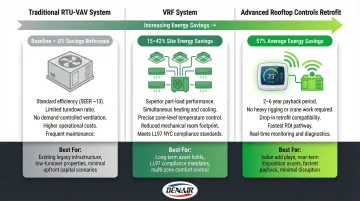
Sometimes the right VE move is spending slightly more upfront on a higher-efficiency unit when lifetime energy savings outweigh the initial premium. VRF systems deliver 15-42% HVAC site energy savings compared to traditional rooftop unit variable air volume (RTU-VAV) systems, making them ideal for long-term holds facing Local Law 97 penalties.
For existing RTUs, retrofitting with Advanced Rooftop Controls (ARC) — including variable frequency drives and demand-controlled ventilation — yields an average of 57% energy savings with a 2-to-6-year payback. This VE alternative avoids heavy rigging and equipment costs while cutting operating expenses significantly.
Controls and Building Automation Simplification
The savings potential from equipment upgrades extends directly into controls. Specifying overly complex BAS sequences for smaller commercial buildings adds cost without added value — simplified but code-compliant control strategies reduce both equipment and commissioning costs.
Smart controls and dual-fuel systems can cut energy costs by up to 50%, but only when the controls architecture matches the building. A 5,000-square-foot retail space has very different needs than a 200,000-square-foot office tower, and over-specifying for the smaller building wastes budget on complexity that no one will use.
Labor and Installation Scope Optimization
Ductwork routing, access panel placement, and equipment curb specifications all carry labor cost implications. An experienced Brooklyn contractor who knows local DOB requirements and building construction types can streamline the installation scope without creating compliance risk.
Common labor-saving opportunities include:
- Consolidating rooftop equipment replacements into a single mobilization to avoid multiple crane permit fees ($3,000+ per lift)
- Optimizing ductwork routing to reduce sheet metal fabrication hours
- Coordinating DOT street occupancy permits across trades in a single application
Why Brooklyn Buildings Face Unique HVAC Cost Pressures
Brooklyn's building stock and regulatory environment combine to push HVAC project costs higher at every turn — which is exactly why value engineering carries real weight here.
Pre-War Construction Constraints
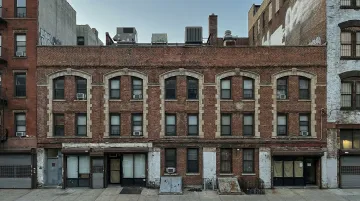
87.2% of mixed-use buildings and 62.9% of commercial buildings in Brooklyn were built before 1945. These pre-war structures present:
- Constrained mechanical rooms with no room for modern equipment
- Non-standard floor-to-floor heights that complicate ductwork routing
- Existing ductwork configurations that make cookie-cutter HVAC designs expensive to install
- Load-bearing masonry walls that complicate penetrations
VE strategies must prioritize ductless or flexible systems (like VRF) that navigate spatial, structural, and electrical constraints without triggering costly structural reinforcements.
NYC Local Law 97 Carbon Emissions Caps
NYC Local Law 97 carbon emissions caps are creating urgency for building owners to upgrade aging HVAC systems. While only 11% of buildings are projected to exceed limits in 2024-2029, 63% will face penalties starting in 2030 — at $268 per metric ton of CO2e over the limit.
VE helps identify the highest-efficiency compliant options within budget constraints, balancing upfront capital cost against long-term carbon penalty exposure.
DOB Permit and Filing Requirements
NYC DOB permit and filing requirements add cost layers that a locally experienced contractor can navigate more efficiently. Key fees to account for:
- Crane permits: $300–$3,000+ depending on equipment and duration
- Sidewalk shed permits: $160 base fee plus $10 per additional 25 feet
- ECB violations for expired shed permits: up to $8,000 per violation
Understanding the correct job type — Alteration CO versus Professional Certification — can dramatically reduce review timelines and soft costs.
Density and Access Challenges
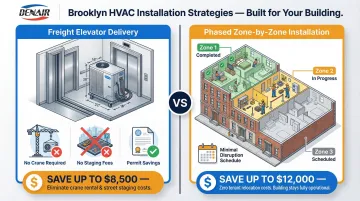
Brooklyn commercial projects routinely involve limited crane access, tight sidewalk shed windows, and tenants who can't tolerate extended shutdowns. Installation sequencing that minimizes disruption has real dollar value — not just operational value.
Two approaches consistently reduce costs here:
- Freight elevator delivery: Modular VRF systems sized to fit building elevators bypass crane permits and staging fees entirely
- Phased installation: Sequencing work zone-by-zone keeps occupied buildings running throughout the upgrade
How to Choose the Right HVAC Value Engineering Contractor in Brooklyn
Three Non-Negotiables
The contractor must have:
- NYC commercial experience — direct familiarity with DOB requirements, Local Law 97 compliance, and the building types common across Brooklyn
- A dedicated estimating function — documented alternates and written scope breakdowns, not verbal promises
- Manufacturer relationships — access to multiple equipment lines so comparisons are genuine, not pre-decided
Fixed-Proposal Pricing
A contractor who guarantees their proposal price and absorbs unintended costs protects the client from VE savings being eroded by change orders. Low bids that get padded through post-award change orders can wipe out any VE savings entirely.
Denair HVAC backs this with a fixed-proposal pricing guarantee — if unintended costs arise, they absorb them. No mid-project surprises, no eroded savings.
Local Expertise and Track Record
Denair HVAC is headquartered in Brooklyn (8319 20th Ave) and has operated in NYC commercial construction for over 19 years. Their credentials include Inc. 5000 recognition and a lead estimator, Farrukh Kasimov, who has been with the firm since 2010. In documented results, their VE work has helped clients save over $186,000 in the past six months alone.
To request a value engineering review for your next project, contact Denair at 212-776-1333.
Frequently Asked Questions
What is HVAC value engineering?
HVAC value engineering is a structured process of reviewing a project's mechanical specifications to identify alternative equipment or system designs that achieve the same performance at a lower cost. It preserves quality and code compliance while eliminating unnecessary cost premiums.
How much does HVAC cost in NYC?
Commercial HVAC costs in NYC vary widely by building size, system type, and complexity. RSMeans 2024 data shows mechanical costs ranging from $12.40 to $32.50 per square foot for office buildings, with NYC location factors typically increasing base figures by 25-35%. Value engineering can reduce that baseline by up to 35%.
How much can value engineering save on a commercial HVAC project in Brooklyn?
Denair HVAC clients saved over $186,000 in the last six months through value-engineered equipment alternatives. Savings of up to 35% of the HVAC budget are achievable depending on how early in the project VE is engaged and the extent of over-specification in the original design.
Does value engineering mean lower quality HVAC equipment?
No. Legitimate VE substitutes equipment that meets or exceeds the original specification's performance requirements and carries equivalent warranty coverage. Quality is maintained; only unnecessary cost premium is removed. Federal procurement guidelines explicitly favor performance-based specifications to encourage competition without sacrificing quality.
What is the $5,000 rule for HVAC?
The $5,000 rule is an industry decision heuristic: multiply the system's age (in years) by the repair cost estimate; if the result exceeds $5,000, replacement is typically more economical than repair. For commercial facilities, though, ASHRAE recommends a formal Life-Cycle Cost (LCC) analysis rather than this simplified formula.
How to choose an HVAC contractor?
Key criteria to evaluate:
- Verify NYC mechanical contractor licensing and commercial Brooklyn project experience
- Confirm written fixed pricing and documented VE alternates are offered
- Check references from similar building types
- Look for a dedicated estimating function and direct manufacturer relationships