Introduction
Brooklyn building owners are facing a compliance crisis many don't yet realize. Local Law 97 (LL97) compliance periods are already underway, with annual greenhouse gas emissions reports due every May 1st and financial penalties beginning in 2025. Many Brooklyn buildings—particularly older pre-war multifamily and co-op properties built before 1940—are likely exceeding their carbon limits without realizing it.
That unawareness often traces back to one root cause: the HVAC system. Space heating and domestic hot water alone account for approximately 70% of total energy use in NYC multifamily buildings, making them the single biggest driver of LL97 non-compliance. Understanding what upgrades are required, what they cost, and how they compare to mounting penalties is critical financial planning for any building owner.
TLDR
- LL97 applies to NYC buildings over 25,000 sq ft and sets carbon emissions caps starting in 2024, with stricter limits in 2030
- HVAC systems drive roughly 70% of a building's carbon emissions and are the main target for compliance upgrades
- Penalties for exceeding emissions limits are $268 per metric ton over the cap—costs that quickly outpace equipment upgrades
- Brooklyn holds over 50% of NYC's pre-1940 multifamily building stock, putting it at higher non-compliance risk than any other borough
What Is LL97 and Why Brooklyn Building Owners Should Pay Attention
Legislative Origins and Escalating Caps
Enacted as the centerpiece of the 2019 Climate Mobilization Act, LL97 mandates that NYC's largest buildings reduce their greenhouse gas emissions by 40% by 2030, with a long-term goal of 80% reduction by 2050. This law is about carbon output, not just energy use—the fuel type powering your HVAC matters as much as equipment efficiency.
The law operates across two escalating compliance periods:
- Phase 1 (2024–2029): Current emissions caps
- Phase 2 (2030–2034): Significantly stricter limits
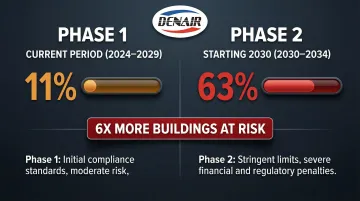
According to a 2022 city analysis, while only 11% of covered buildings are projected to exceed Phase 1 limits, a staggering 63% are projected to exceed Phase 2 limits starting in 2030. Buildings that begin HVAC upgrades now will be far better positioned than those who wait.
Brooklyn's Unique Vulnerability
That penalty risk falls hardest on Brooklyn. The borough contains 60,181 pre-war multifamily tax lots out of a citywide total of 118,775 — more than 50% of NYC's aging residential stock concentrated in one borough. Most of these buildings rely on inefficient steam heating systems that are among the heaviest carbon emitters covered by LL97.
The neighborhoods with the highest concentration of at-risk properties include:
- Park Slope and Cobble Hill
- Sunset Park
- Williamsburg and Bushwick
- Bedford-Stuyvesant
Over 70% of multifamily properties covered by LL97 are seven stories or less, and more than half were built before 1940. For Brooklyn owners, that combination of age, building type, and heating fuel creates significant Phase 2 exposure.
Which Brooklyn Buildings Must Comply with LL97
Covered Building Definitions
LL97 determines compliance by square footage as recorded by the NYC Department of Finance. A "covered building" is defined as:
- A single building exceeding 25,000 gross square feet
- Two or more buildings on the same tax lot totaling over 50,000 gross square feet
- Two or more condo/co-op buildings governed by the same board totaling over 50,000 gross square feet
Approximately 27,000+ NYC buildings are covered, with residential multifamily properties accounting for roughly 18,000 buildings—60% of total covered square footage.
Key Exemptions and Alternative Pathways
Certain properties have exemptions or delayed compliance timelines:
Delayed Compliance:
- Buildings with at least one rent-regulated unit (but no more than 35%) may delay compliance until 2026
- Income-restricted housing (e.g., Mitchell-Lama) may delay until 2035
Prescriptive Pathway (Article 321):
- Buildings with more than 35% rent-regulated units and houses of worship can comply by implementing a prescriptive checklist of low-cost energy upgrades rather than meeting strict carbon caps
Full Exemptions:
- NYC government-owned buildings
- NYCHA housing
- Industrial facilities primarily used for power/steam generation
- Certain garden-style apartments
Landmark Flexibility: Historic and landmarked buildings are not fully exempt. Under Administrative Code § 28-320.7, they may apply for temporary adjustments to emissions limits if strict compliance is prevented by legal constraints or physical conditions.
Verify Your Building's Status
Since exemption categories and compliance deadlines vary by building type, confirming your exact status is the logical first step before planning any upgrades.
The NYC Accelerator Building Energy Snapshot tool pulls DOB records to show your building's compliance status and current emissions score. When reviewing your snapshot, look for:
- Your building's current carbon intensity score vs. the applicable cap
- Which compliance period applies (2024–2029 or 2030–2034)
- Whether any exemption or alternative pathway applies to your property
Why HVAC Is the Most Critical Factor in LL97 Compliance
Thermal Systems Dominate Multifamily Emissions
In large NYC multifamily buildings, space heating and domestic hot water account for approximately 70% of total site energy use and nearly three-quarters of total greenhouse gas emissions. Because heating and hot water leave little room for other energy uses under LL97 caps, compliance centers on HVAC.
The LL97 Emissions Calculation Formula
A building's annual emissions are calculated using a formula set by law:
Annual GHG Emissions = ∑ (Annual fuel use × Emissions Coefficient of the fuel type)
| Fuel Type | 2024–2029 Emissions Factor | 2030–2034 Emissions Factor |
|---|---|---|
| Grid Electricity | 0.000288962 tCO₂e / kWh | 0.000145 tCO₂e / kWh |
| Natural Gas | 0.00005311 tCO₂e / kBtu | 0.00005311 tCO₂e / kBtu |
| No. 2 Fuel Oil | 0.00007421 tCO₂e / kBtu | 0.00007421 tCO₂e / kBtu |
| No. 4 Fuel Oil | 0.00007529 tCO₂e / kBtu | 0.00007529 tCO₂e / kBtu |
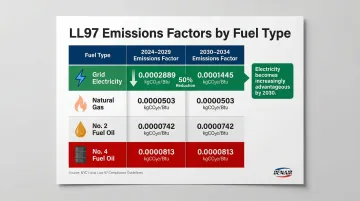
Heavy fuel oils carry the highest penalty weight per unit of energy. Meanwhile, electricity's penalty factor drops by nearly 50% in 2030 as New York's grid becomes cleaner under the Climate Leadership and Community Protection Act (CLCPA) — making electrification increasingly attractive for 2030-cycle compliance.
The Heavy Oil Double-Jeopardy
Approximately 3,200 NYC buildings still use No. 4 fuel oil, with about 1,650 running exclusively on No. 4 boilers. These buildings face a compounding problem:
- Highest penalty factor — No. 4 oil carries the steepest LL97 emissions coefficient of any common fuel type
- Mandatory phaseout — NYC regulations require complete elimination of No. 4 oil by 2030, regardless of LL97 status
- Dual deadline pressure — buildings must plan boiler replacements that satisfy both the phaseout requirement and the tightening 2030 emissions caps simultaneously
Building Use Classification Matters
Emissions limits per square foot vary by property type as determined by EPA Energy Star Portfolio Manager categories. A Brooklyn co-op has a different per-square-foot carbon cap than a mixed-use commercial building. For example, the 2024–2029 emissions limit for R-2 residential multifamily is 0.00675 tCO₂e/sf. Confirm your building's occupancy classification before estimating penalties — misclassifying a mixed-use building as purely residential can significantly understate your actual exposure.
Understanding where your building stands against these caps is the first step. The next is identifying which HVAC systems are driving the bulk of your emissions.
HVAC Upgrades That Help Brooklyn Buildings Meet LL97 Standards
Heat Pump Systems (Air-Source and Water-Source)
Electrifying heating and cooling via heat pumps is one of the most impactful LL97 compliance strategies because electricity has a lower—and rapidly declining—carbon emissions factor than gas or oil under LL97's formula.
Relevant Applications for Brooklyn Multifamily:
- PTAC-style heat pumps for individual units
- VRF (Variable Refrigerant Flow) systems for mid-rise buildings
- Air-source heat pump boilers for central hot water
As NYC's electric grid reaches 70% renewable energy by 2030 under the CLCPA, the emissions benefit of electrification will grow. Case studies show that multifamily heat pump retrofits can reduce residential carbon emissions by at least 20% compared to legacy steam systems.
High-Efficiency Boiler and HVAC Equipment Replacement
For buildings not yet ready for full electrification, upgrading from old oil or low-AFUE gas boilers to high-efficiency condensing boilers can reduce emissions factors. Switching from No. 4 to No. 2 fuel oil also helps, though phaseout timelines make this a short-term fix.
An oversized boiler wastes fuel. A properly engineered replacement sized to actual building load reduces both emissions and energy cost. Denair HVAC's value engineering approach identifies equipment with equal or better performance at lower cost — Brooklyn property managers can reduce capital spend while still hitting LL97 targets.
Building Automation Systems (BAS) and Smart Controls
Even efficient equipment produces excess emissions if it runs unnecessarily. BAS and programmable controls optimize HVAC scheduling, respond to occupancy patterns, and prevent simultaneous heating and cooling.
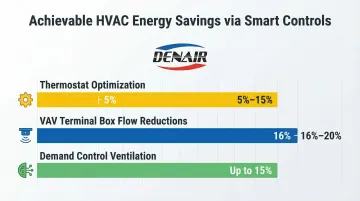
Research by Pacific Northwest National Laboratory quantifies achievable HVAC energy savings:
- Thermostat optimization (widening deadbands, night setbacks): 5% to 15% total site energy savings
- VAV terminal box flow reductions: 16% to 20% savings
- Demand control ventilation: Up to 15% savings in applicable spaces
Envelope Improvements That Reduce HVAC Load
While not HVAC upgrades themselves, improved insulation, window upgrades, and air sealing reduce the heating/cooling load the HVAC system must meet—meaning the same equipment produces fewer emissions. For pre-war Brooklyn brownstones and co-ops, this can be a cost-effective complement to equipment upgrades. Roof insulation and pipe insulation for steam systems are particularly valuable.
Annual Preventative Maintenance as an Ongoing Compliance Tool
Structural upgrades get you to compliance — maintenance keeps you there. Dirty coils, refrigerant leaks, and misaligned equipment cause HVAC systems to run harder and longer, increasing energy use and carbon output. Consistent professional maintenance is a direct factor in sustaining the emissions performance required for annual LL97 reporting.
Denair HVAC offers free preventative maintenance for up to 18 months on new installations, helping Brooklyn property managers sustain LL97 compliance year over year.
LL97 Penalties, Compliance Timeline, and Immediate Steps
Penalty Structure
Failure to comply with LL97 results in severe, compounding financial penalties:
| Violation Type | Penalty Amount | Enforcement Mechanism |
|---|---|---|
| Emissions Overage | $268 per metric ton of CO₂e | Assessed annually for emissions exceeding the building's assigned cap |
| Failure to Report | $0.50 per square foot per month | Assessed monthly until the annual GHG report is submitted |
| False Reporting | Up to $500,000 / Imprisonment | NYC Administrative Code § 28-211.1 makes material false statements unlawful |
Illustrative Penalty Scenario
Consider a hypothetical 50,000 sq ft Brooklyn multifamily building (Occupancy Group R-2) with an annual cap of 337.5 tCO₂e:
- If the building emits 437.5 tCO₂e (100 tons over the cap), the annual emissions penalty is $26,800 (100 tons × $268)
- If the building simply fails to file its report, the penalty is $25,000 per month (50,000 sq ft × $0.50), totaling $300,000 per year
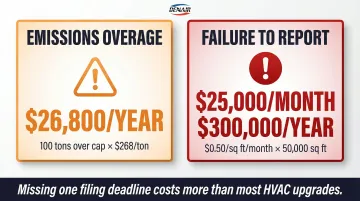
These numbers scale fast. For a mid-size Brooklyn apartment building, missing a single reporting deadline costs more than most HVAC upgrades.
Annual Reporting Requirement
Starting May 1, 2025, all covered buildings must submit a Greenhouse Gas Emissions report to the NYC Department of Buildings (DOB), certified by a registered design professional. The report reflects the prior calendar year's emissions.
LL97 caps tighten sharply in the 2030–2034 phase — buildings starting HVAC upgrades now will reach those thresholds with far less urgency than those who wait.
Immediate Steps Checklist for Brooklyn Building Owners
- Determine if your building is covered using NYC Accelerator's Building Energy Snapshot tool
- Identify your building's current emissions using ENERGY STAR Portfolio Manager
- Estimate potential penalties using the Building Energy Exchange LL97 calculator
- Consult with a registered mechanical contractor to scope HVAC upgrade options and timeline before the next reporting period
Frequently Asked Questions
What buildings are subject to Local Law 97?
Buildings over 25,000 gross sq ft, two or more buildings on the same tax lot totaling over 50,000 sq ft, and condo/co-op buildings under the same board exceeding 50,000 sq ft are covered—approximately 27,000+ NYC buildings in total.
What are the rules for LL97 in NYC?
Covered buildings must stay within annual carbon emissions caps (measured in tCO₂e per sq ft by building type), submit yearly GHG reports to the DOB by May 1, and meet stricter caps starting in 2030—with fines of $268 per metric ton over the limit for non-compliance.
What is the difference between LL97 and LL84?
LL84 requires covered buildings to track and report energy and water use annually via ENERGY STAR Portfolio Manager — it is a transparency law with no penalties for high usage. LL97 goes further by setting hard carbon emissions limits with fines for exceeding them; LL84 data typically serves as the baseline for LL97 compliance calculations.
How will Local Law 97 affect air quality?
LL97 pushes buildings away from fossil fuel combustion toward electrified, higher-efficiency HVAC systems. This is expected to reduce localized air pollution from building exhaust — a meaningful benefit for dense Brooklyn neighborhoods where aging boilers contribute to particulate matter and NOx emissions.
When do LL97 penalties start?
Penalties began accruing for calendar year 2024 emissions, with the first annual GHG reports due May 1, 2025. Buildings that exceeded their 2024 cap are already liable for fines — owners who haven't acted yet face immediate financial exposure.
What HVAC upgrades help most with LL97 compliance in Brooklyn?
Heat pump electrification, high-efficiency boiler replacement (especially replacing No. 4 oil systems), and Building Automation Systems are the top-impact upgrades—particularly for Brooklyn's large stock of pre-war multifamily buildings with outdated central heating systems.
Ready to assess your building's LL97 compliance status? Contact Denair HVAC at (212) 776-1333 for a consultation on HVAC upgrade options tailored to Brooklyn multifamily buildings and co-op boards. With over 19 years of experience serving NYC's commercial building sector, Denair's registered mechanical contractors can help you navigate compliance requirements while optimizing your capital investment.