
Introduction
Manhattan commercial buildings are leaving serious money on the table. Studies consistently show that existing buildings waste 15–30% of the energy they consume—not from equipment failure, but from control sequences that have drifted, sensors that have lost calibration, and building automation systems loaded with overrides that quietly compound into chronic inefficiency.
Meanwhile, Local Law 97 penalties are already in effect, tenant comfort complaints are climbing, and energy costs aren't going down.
Retro-commissioning (RCx) is a systematic process that recovers lost performance, reduces utility spending, and supports compliance—without full equipment replacement. It closes the gap between how your systems were designed to run and how they actually perform today. This guide covers what the RCx process involves, what savings are realistic for Manhattan properties, and how city regulations make it increasingly difficult to ignore.
Key Takeaways
- Retro-commissioning optimizes existing building systems through investigation and correction—not replacement
- Manhattan buildings quietly shed efficiency through sensor drift, control overrides, and occupancy pattern shifts — driving up energy bills without triggering any alarms
- NYC Local Law 87 mandates RCx for buildings over 50,000 sq ft every 10 years—making it legally required
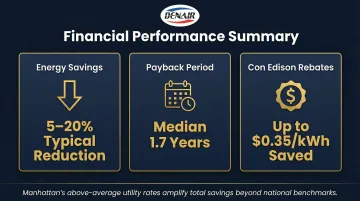
- Well-executed RCx typically reduces energy use by 5-20%, with payback periods under 2 years
- Denair HVAC has served Manhattan commercial properties since 2007 — handling both the diagnostic work and any mechanical corrections needed in-house
What Is Retro-Commissioning and Why Do Manhattan Buildings Need It
Retro-commissioning (RCx) is a structured, diagnostic process that evaluates existing building systems, primarily HVAC, lighting controls, and building automation, to restore them to peak operational efficiency without replacing equipment. Unlike new construction commissioning, which confirms systems work as designed at completion, RCx targets buildings already in operation where performance has degraded over years of use.
Rather than replacing what's installed, RCx identifies performance gaps through testing, adjusts control sequences, recalibrates sensors, and corrects operational faults. The goal is making systems work as originally intended.
Why Manhattan Buildings Are Especially Vulnerable: Manhattan's commercial building stock, dominated by aging pre-war and mid-century structures, faces unique challenges. Complex multi-tenant demands, round-the-clock operations, and NYC's extreme seasonal temperature swings accelerate system degradation. Buildings over 50,000 square feet represent only 2% of NYC's building stock but account for nearly half of all built square footage, and many were constructed during the 1920s, 1950s, and 2000s booms.
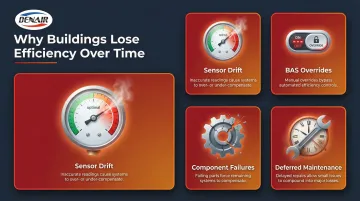
The Core Problem RCx Solves: Buildings gradually stray from their original design intent through:
- Sensor drift — Sensors lose calibration, causing systems to operate based on false readings
- BAS overrides — Control devices placed in manual override to address individual complaints are never reset
- Component failures — Malfunctioning dampers, leaking valves, and broken actuators
- Deferred maintenance — Lack of time or training to diagnose and correct building automation issues
Manhattan-Specific Urgency: NYC's carbon emissions penalties under Local Law 97 and energy benchmarking requirements under Local Law 84 create real financial and legal consequences for building owners whose systems underperform. A single RCx engagement can serve multiple regulatory purposes at once: satisfying LL87 compliance requirements while reducing the carbon output that triggers LL97 penalties.
Warning Signs Your Manhattan Building Is Due for Retro-Commissioning
Four operational patterns consistently indicate that retro-commissioning would deliver measurable returns:
Unexplained or Gradual Energy Bill Increases: RCx is ideal for buildings where energy use has been increasing without a known cause, or where there are unexplained energy spikes. While no universal threshold exists, energy use increases of 10-15% year-over-year without corresponding occupancy or operational changes typically signal operational problems worth investigating.
Frequent Tenant Comfort Complaints: Hot and cold spots, inconsistent temperatures across floors or zones, and persistent HVAC-related complaints strongly indicate that controls and setpoints have drifted or been manually overridden without proper recalibration. Each unresolved complaint is a symptom of a system fault draining energy across the whole building.
Accumulation of Operator Overrides in the BAS: When maintenance staff repeatedly override automated control sequences, control devices and sensors often stay disabled or locked in manual mode indefinitely — never reset to their original sequences. Each "quick fix" compounds into sustained excess energy consumption at a building-wide level.
Equipment Age Without Recent Tune-Up: RCx delivers maximum value when equipment is within its useful operational life but mis-sequenced or poorly controlled. ASHRAE data shows that electronic controls have a median useful life of 15 years, VAV boxes 20 years, and chillers 20-23 years. Systems roughly 5-15 years old that are underperforming are strong RCx candidates. Beyond that range, replacement is typically the more cost-effective path.
The Retro-Commissioning Process: What to Expect Step by Step
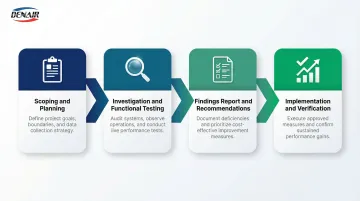
Scoping and Planning
The RCx engagement begins with a planning phase: reviewing existing documentation (original mechanical drawings, BAS sequences, past maintenance logs, utility bills) and setting clear performance benchmarks and energy reduction targets specific to your building. This phase establishes the Current Facility Requirements (CFR) and develops the initial commissioning plan.
Investigation and Functional Testing
The RCx provider conducts on-site walkthroughs, interviews facility staff, and performs functional testing of mechanical systems—including air handling units, chillers, cooling towers, VAV boxes, sensors, and controls.
Functional testing runs under full operation across various modes—low/high loads, unoccupied, and power failure scenarios—to identify where performance deviates from design intent.
Typical testing scope includes:
- Validating AHU and VAV valves and dampers open/close without restriction per sequence of operations
- Testing chiller and boiler staging and sequencing across varying load conditions
- Verifying BAS analog/digital inputs and outputs, setpoints, reset schedules, and release of any manual overrides
Findings Report and Recommendations
Findings are compiled into a formal report listing identified deficiencies, proposed corrective measures ranked by cost-effectiveness and payback period, and projected energy savings for each measure. Building owners receive a clear, prioritized action plan with projected savings attached to each item.
Implementation and Verification
Low- and no-cost measures are implemented first, including:
- Control sequence corrections
- Setpoint adjustments
- Schedule optimization
- Sensor recalibration
Minor capital measures follow where needed. Post-implementation monitoring then verifies that projected savings are actually achieved.
NYC Local Law 87: When Retro-Commissioning Isn't Optional
NYC Local Law 87 (LL87) requires buildings over 50,000 sq ft in New York City to complete energy audits and retro-commissioning on a ten-year cycle tied to their block/lot number. This makes RCx a legal obligation, not an elective efficiency project, for the vast majority of large Manhattan commercial buildings.
What LL87 Compliance Requires:
- A certified energy audit (ASHRAE Level II) and a retro-commissioning study conducted by a qualified professional
- Documentation filed with the NYC Department of Buildings (DOB)
- As of January 1, 2022, an Energy Efficiency Report (EER) must be submitted by a Registered Design Professional (RDP)—a New York State licensed Professional Engineer (PE) or Registered Architect (RA)
Filing Deadlines
EERs are due once every 10 years. The last digit of the building's tax block number determines the due year (for example, a block ending in "4" was due in 2014 and again in 2024; ending in "5" is due in 2025).
Penalties for Non-Compliance
"Failure to submit an acceptable EER is a Major (Class 2) violation which may result in a penalty of $3,000 in the first year and $5,000 for each additional year until the EER is submitted." Penalties are cumulative.
Intersection with LL84 and LL97:
LL87 compliance feeds into the broader NYC sustainability framework. LL84 requires annual benchmarking via EPA's ENERGY STAR Portfolio Manager, and that ESPM data automatically feeds into the LL97 BEAM portal. However, an LL87 EER cannot be uploaded to satisfy LL97 Article 321 requirements — they're separate obligations.
That said, a single RCx engagement can identify the exact operational adjustments needed to stay under tightening LL97 emissions caps, making it useful well beyond LL87 compliance alone.
The Financial Case for Retro-Commissioning in Manhattan
Energy Savings Ranges: A 2020 meta-analysis by Lawrence Berkeley National Laboratory of 1,500 North American buildings found median primary energy savings of 6.4% overall, but 14% median savings for existing building commissioning (EBCx) projects conducted outside of restricted utility programs. Manhattan's high commercial utility rates amplify the dollar value of these percentage savings compared to national averages.
ROI and Payback Period: The same 2020 LBNL study found a median simple payback time of 1.7 years (with a 25th-75th percentile range of 0.8-3.5 years). Older EPA/LBNL data cited a median benefit-cost ratio of 4.5—effectively $4.50 saved per $1 invested. NYC's above-average utility rates compress those payback windows further — and the numbers below show why.
Manhattan Utility Rate Context: As of December 2025, Manhattan commercial buildings face some of the highest utility rates in the country:
| Energy Type | Rate | Source |
|---|---|---|
| Commercial electricity | $0.2061/kWh | EIA, Dec 2025 |
| Con Edison demand charge (summer peak) | Up to $20.75/kW | Con Edison tariff |
| Natural gas | $11.47/Mcf (~$1.11/therm) | EIA, Dec 2025 |
For a building spending $300,000 annually on energy, a 14% reduction from RCx saves $42,000 per year — paying back a typical project in under two years.
NYC Utility Rebate Programs: Con Edison's Commercial and Industrial Energy Efficiency Program offers incentives for qualifying energy conservation measures identified through RCx. Building owners should ask their RCx provider to identify applicable rebates during the study phase to offset project costs. Eligible measures include:
- Building Automation Systems (BAS): $0.35 per kWh saved
- Variable Frequency Drives (VFDs): $0.19/kWh (prescriptive) or $0.35/kWh (custom)
Choosing the Right Retro-Commissioning Provider in Manhattan
Key Qualifications to Look For:
- Licensing as a registered mechanical/HVAC contractor in New York
- Documented experience with Manhattan building types (commercial, multifamily, medical, retail)
- Familiarity with NYC DOB filing requirements for LL87 compliance
- References from comparable projects
- Adherence to ASHRAE Guideline 0.2-2015 or Building Commissioning Association (BCxA) standards
Once you've confirmed those baseline credentials, the next factor worth evaluating is whether your provider can act on what they find.
The Value of Combined RCx and Corrective Capacity
Selecting a contractor who combines RCx expertise with full-service HVAC capabilities reduces project delays and extra coordination effort. If the investigation reveals issues requiring corrective work beyond control adjustments, a provider who can execute those repairs—not just document them—delivers faster results.
Denair HVAC is a registered NYC mechanical contractor with over 19 years of experience serving Manhattan commercial buildings. The company offers system commissioning, air balancing with certified reports, and corrective mechanical work—covering the full scope from diagnosis to implementation without handoffs to outside contractors.
Transparent Pricing
Request itemized proposals that separate study fees from implementation costs, and confirm the provider follows ASHRAE or BCxA methodology standards.
Frequently Asked Questions
How much does retro-commissioning cost in Manhattan?
Costs vary by building size, system complexity, and corrective scope. The 2020 LBNL study found a median EBCx cost of $0.26 per square foot — dropping to $0.09–$0.21/sq ft for buildings over 400,000 sq ft. Utility rebates from Con Edison and energy savings typically offset a meaningful share of that investment.
What is the difference between retro-commissioning and new construction commissioning?
New construction commissioning verifies systems work as designed at the time of project completion. Retro-commissioning is performed on buildings already in operation to recover performance that has degraded over time—they address different points in a building's lifecycle.
Does NYC Local Law 87 require retro-commissioning?
Yes. LL87 mandates both an energy audit and a retro-commissioning study for NYC buildings over 50,000 sq ft on a 10-year cycle, with required filing to the NYC Department of Buildings and penalties for non-compliance.
How long does a retro-commissioning project typically take?
Most commercial RCx projects run several weeks to a few months, depending on building size. The investigation and reporting phase wraps up first; implementation proceeds on the owner's timeline.
What building systems are evaluated during retro-commissioning?
RCx evaluates the highest energy-consuming systems first: HVAC equipment (air handlers, chillers, cooling towers, VAV systems), building automation and controls, lighting controls, and the building envelope as it affects mechanical load.
How much energy can Manhattan buildings typically save through retro-commissioning?
Industry-documented savings range from 5–20%+ of total building energy use, with median savings of 14% for EBCx projects. Manhattan's elevated electricity and gas rates mean even modest percentage reductions translate into substantial annual dollar savings for building owners.