A Dedicated Outdoor Air System (DOAS) solves this by separating fresh air delivery from heating and cooling, allowing buildings to meet modern ventilation codes without the energy penalty. For Brooklyn commercial property owners facing Local Law 97 penalties starting in 2024, DOAS isn't just an upgrade—it's a compliance tool that cuts carbon emissions while improving tenant comfort and retention.
This article covers what DOAS is, how it benefits Brooklyn commercial buildings, the installation process, and how to find the right contractor locally.
Key Takeaways
- DOAS supplies conditioned fresh outdoor air independently from your heating/cooling equipment
- Reduces HVAC energy consumption by 42-61% and supports NYC Local Law 97 compliance
- Brooklyn buildings with high occupancy, aging equipment, or code compliance triggers are strong candidates
- Installation pairs DOAS with an ERV and works best alongside VRF or mini-split systems
- Denair HVAC handles DOAS installation, maintenance, and retrofits in Brooklyn — with fixed proposal pricing
What Is a Dedicated Outdoor Air System (DOAS)?
Purpose-Built Ventilation Separate from Heating and Cooling
A DOAS is a mechanical ventilation system designed exclusively to deliver pre-conditioned outdoor air to occupied spaces — separate from the system that handles heating and cooling loads. According to the U.S. Department of Energy, DOAS equipment conditions 100% outdoor air, allowing the primary HVAC system to focus solely on temperature control.
That decoupling is the core design advantage. Conventional HVAC systems bundle both functions together, forcing the equipment to run whenever fresh air is needed — even when heating or cooling isn't required. DOAS handles ventilation loads independently, which cuts the building's overall heating and cooling demands.
How Energy Recovery Ventilators Work Within DOAS
Most DOAS installations include an Energy Recovery Ventilator (ERV) that pre-conditions incoming outdoor air by exchanging heat with exhausted indoor air. The two air streams never mix, keeping pollutants and odors out of the fresh supply. Modern ERV cores operate at 70–93% efficiency, recovering most of the heating or cooling energy that would otherwise be lost through exhaust.
How it works in practice:
- In winter, warm exhaust air pre-heats cold incoming air
- In summer, cool exhaust air pre-cools hot incoming air
- Moisture transfer occurs simultaneously, reducing humidity loads
Three Core Components of a Complete DOAS Solution
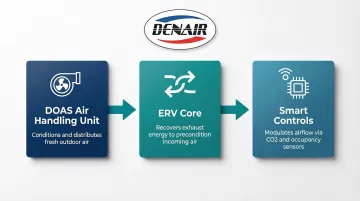
A typical DOAS installation includes:
- DOAS air handling unit – Conditions and distributes fresh outdoor air
- ERV core – Preconditions incoming air by recovering exhaust energy
- Smart controls – Linked to CO2 and occupancy sensors that modulate airflow based on actual demand, not fixed schedules
Equipment Downsizing Advantage
Because DOAS handles the ventilation load separately, the heating and cooling equipment no longer needs to fully temper large volumes of outdoor air. This allows for smaller, more efficient HVAC units—a critical advantage for Brooklyn buildings constrained by rooftop or mechanical room space.
Historical Context: Correcting the 1970s Energy Crisis Mistake
The 1973 oil embargo triggered national energy conservation measures that sharply cut outdoor air intake in commercial buildings. ASHRAE Standard 62 lowered ventilation targets by half — to just 5 cfm per occupant — and effectively launched the "sick building era." DOAS is the modern engineering response: buildings can now restore proper ventilation without the heavy energy penalties that made it impractical for decades.
Key Benefits of DOAS for Brooklyn Commercial Buildings
Indoor Air Quality Improvement
DOAS delivers measured, filtered fresh air continuously and independently, reducing CO2 buildup, odors, and airborne contaminants. In densely occupied Brooklyn spaces — medical offices, fitness centers, classrooms — that consistent delivery matters most.
The impact on cognitive function is substantial. A landmark Harvard study found that cognitive function scores were 15% lower at moderate CO2 levels (~945 ppm) and 50% lower at ~1,400 ppm compared to enhanced green building conditions. Traditional systems often struggle to maintain optimal CO2 levels without running heating or cooling simultaneously, but DOAS guarantees 100% fresh air delivery regardless of temperature control needs.
Energy Savings: 42-61% Reduction in HVAC Consumption
DOAS paired with ERV technology delivers significant energy reductions compared to conventional all-air systems. A study by the Northwest Energy Efficiency Alliance found that high-efficiency DOAS with heat recovery can reduce HVAC Energy Use Intensity (EUI) by an average of 61% — ranging from 37% in warmer climates to 71% in cooler climates.
Separate hourly energy simulations of a DOAS/radiant cooling system showed a 42% reduction in annual electrical energy consumption compared to a conventional Variable Air Volume (VAV) system.
NYC Local Law 97 Compliance Relevance
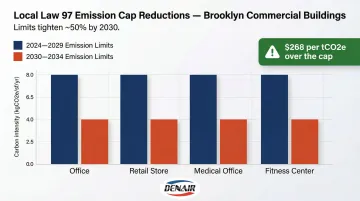
Brooklyn commercial building owners face escalating carbon penalty fines under Local Law 97 starting in 2024, with a civil penalty of $268 per metric ton of CO2 equivalent (tCO2e) over the cap. The limits tighten significantly in 2030, with office buildings facing a roughly 50% reduction in allowable emissions.
DOAS+ERV retrofits directly lower a building's carbon footprint by recovering exhaust energy, thereby reducing the fossil fuels and electricity required for space conditioning. For Brooklyn property owners, this makes DOAS both a compliance tool and an efficiency upgrade.
2024-2030 Local Law 97 Limits for Common Brooklyn Building Types:
| Property Type | 2024-2029 Limit (tCO2e/sf) | 2030-2034 Limit (tCO2e/sf) |
|---|---|---|
| Office | 0.00758 | 0.003697 |
| Retail Store | 0.00758 | 0.002824 |
| Medical Office | 0.01074 | 0.002913 |
| Fitness Center | 0.00987 | 0.003947 |
Occupant Comfort and Tenant Satisfaction
DOAS eliminates the "all or nothing" ventilation problem of conventional systems. Fresh air can be delivered even when heating or cooling isn't running, reducing temperature extremes and improving perceived air quality. Fewer complaints about stuffiness, headaches, and fatigue translate directly into better tenant retention for Brooklyn property managers.
Reduced Maintenance Burden
Better comfort also simplifies operations. Because DOAS separates ventilation from conditioning, each system can be maintained and serviced independently. ERV filters need cleaning every 3-6 months, but overall maintenance demands are lower than combined HVAC units that handle both functions.
DOAS vs. Traditional HVAC: What Brooklyn Building Owners Need to Know
Key Differences:
| Factor | Traditional HVAC | DOAS |
|---|---|---|
| Ventilation approach | Bundled with heating/cooling | Separated and independent |
| Fresh air delivery | Only when heating/cooling runs | Continuous, on-demand |
| Equipment sizing | Oversized to handle fresh air loads | Right-sized for each function |
| Energy efficiency | High energy waste tempering outdoor air | 42-61% lower HVAC energy use |
When Traditional HVAC Is Still Sufficient
Conventional systems may remain appropriate for:
- Smaller spaces with low occupancy
- Buildings with limited budgets for retrofits
- Properties not facing immediate code compliance triggers
When DOAS Becomes the Better Investment
DOAS makes financial and operational sense for:
- High-occupancy commercial spaces (offices, fitness centers, medical facilities)
- Buildings failing current ventilation code requirements
- Properties pursuing energy certifications or Local Law 97 compliance
- Buildings undergoing major renovations or tenant turnovers
DOAS and VRF: The Optimal Pairing
DOAS and Variable Refrigerant Flow (VRF) systems work as a purpose-built pair: DOAS manages ventilation, while VRF handles sensible heating and cooling. Because DOAS pre-conditions supply air close to room temperature, the VRF system operates under a reduced load — cutting energy consumption further than either system achieves alone.
For mid-to-large Brooklyn commercial buildings, this combination delivers:
- Lower peak demand charges by reducing VRF compressor runtime
- Independent zoning control for each building area
- Simpler compliance with NYC ventilation and Local Law 97 requirements
- Reduced mechanical room footprint compared to conventional air handlers
Signs Your Brooklyn Building Needs a DOAS Upgrade
Occupant-Reported Symptoms
Inadequate ventilation often shows up as:
- Frequent complaints about stuffiness, headaches, or fatigue
- Inconsistent temperatures across floors or zones
- Visible condensation or persistent humidity problems
- Odors that don't clear despite cleaning
These symptoms are common in older Brooklyn commercial buildings with outdated VAV or exhaust-only systems that can't deliver adequate fresh air without excessive energy consumption.
Code and Compliance Triggers
NYC Mechanical Code Section 1009.1.1 mandates full code compliance for mechanical systems during a change of occupancy. If a space is changed to a use with higher ventilation demand, the mechanical system must be upgraded to meet current requirements.
That same requirement applies to renovations, changes of use, and buildings pursuing LEED/WELL certification — all of which must meet current ASHRAE 62.1 standards. DOAS is specifically engineered to hit those targets.
ASHRAE 62.1-2022 Minimum Ventilation Rates:
| Occupancy Type | People Rate (cfm/person) | Area Rate (cfm/ft²) |
|---|---|---|
| Office Space | 5 | 0.06 |
| Retail Sales | 7.5 | 0.12 |
| Health Club/Aerobics | 20 | 0.06 |
| Classrooms (Age 9+) | 10 | 0.12 |
Fitness centers and classrooms require 3–4× more outdoor air per person than a standard office — volumes that conventional recirculating systems can't condition efficiently. DOAS handles that load without the energy penalties, which matters directly for Local Law 97 compliance.
Aging Equipment as a Trigger
According to the ASHRAE Service Life and Maintenance Cost Database, the median service life for fresh air units is 18.9 to 21.0 years, while air-to-air heat recovery units have a median life of 10 years.
A DOAS retrofit moves from optional to urgent when any of the following apply:
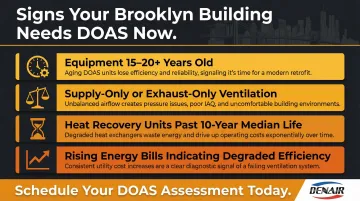
- Ventilation equipment is 15–20+ years old
- The building runs supply-only or exhaust-only ventilation with no balanced ductwork
- Heat recovery units are approaching or past the 10-year median service life
- Rising energy bills point to degraded equipment efficiency
The DOAS Installation Process: What to Expect in Brooklyn
Assessing Your Building's Existing Ventilation Setup
The first step is a site assessment to determine whether the existing system is centralized or decentralized (floor-by-floor), whether supply and exhaust are balanced, and whether existing ductwork can accommodate a DOAS retrofit.
Conversion complexity — and cost — depends on what you're starting with:
- Balanced, decentralized ventilation: Easiest and least expensive to retrofit
- Supply-only or exhaust-only systems: Require additional ductwork, adding scope and cost
- No existing ductwork: Full new distribution required; highest project complexity
A qualified estimator should provide a detailed scope breakdown before any commitment.
Equipment Selection and Value Engineering
According to NYC Accelerator guidance, ERVs should be sized to operate at 40–60% of their rated capacity during design conditions. This allows the ERV to run as an economizer during mild Brooklyn weather (spring and fall), providing free cooling without activating the compressor.
The greatest energy savings occur when DOAS is paired with a high-efficiency VRF or mini-split system. Because the DOAS handles ventilation loads separately, both systems can be right-sized for their specific function. Denair HVAC's value engineering approach finds equipment that matches performance specs at a lower price point, saving clients up to 35% on their HVAC budget.
Controls Integration and Commissioning
DOAS terminal units must be linked to occupancy and CO2 sensors so airflow adjusts to actual occupancy rather than running at fixed rates. Economizer settings should auto-enable during mild weather to maximize free cooling hours.
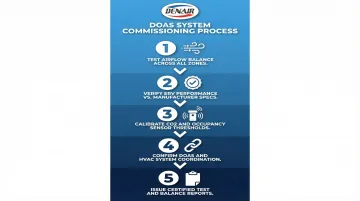
Commissioning typically covers:
- Testing airflow balance across all zones
- Verifying ERV performance against manufacturer specifications
- Calibrating sensor thresholds for CO2 and occupancy
- Confirming that DOAS and heating/cooling systems operate in coordination
- Providing certified test and balance reports
This process is typically completed before the contractor hands over the system, ensuring it performs as designed from day one.
Why Brooklyn Businesses Choose Denair HVAC for DOAS Services
Denair HVAC is a Brooklyn-headquartered commercial HVAC contractor (8319 20th Ave., Suite 200) with over 19 years of experience serving commercial properties across NYC. Recognized by Inc. 5000 as one of America's fastest-growing companies, the team has completed over 400 projects across the five boroughs — including DOAS installations in some of Brooklyn's most demanding commercial spaces.
Service-Specific Differentiators for DOAS Clients:
- Guaranteed fixed pricing — any unintended costs are covered at Denair's expense, not yours
- Free preventive maintenance for up to 18 months on new DOAS installations
- Manufacturer's warranty up to 10 years on new equipment and parts
- Same-day service, typically within 4 hours for urgent issues
- Value engineering that can reduce your HVAC budget by up to 35%
These differentiators matter most in buildings where DOAS performance directly affects occupant health and code compliance. Denair serves a wide range of Brooklyn commercial properties:
Common Brooklyn Building Types Requiring DOAS:
- Office buildings
- Medical and urgent care facilities
- Fitness centers
- Retail stores
- Multi-family residential
- Educational facilities
With headquarters in Brooklyn and 400+ completed NYC projects, Denair's team knows the specific challenges of older building stock, rooftop space constraints, and Local Law compliance requirements firsthand.
Frequently Asked Questions
What does a dedicated outdoor air system do?
A DOAS supplies pre-conditioned fresh outdoor air directly to occupied spaces, independent from the building's heating and cooling system. It improves indoor air quality while reducing the energy load on HVAC equipment by using an ERV to recover exhaust energy.
How does a DOAS differ from a traditional HVAC system?
Traditional HVAC systems bundle ventilation with heating and cooling, requiring the system to run to deliver fresh air. DOAS separates the two functions, allowing fresh air delivery on demand and enabling smaller, more efficient heating and cooling equipment.
Can DOAS be retrofitted into existing commercial buildings?
DOAS retrofits are feasible in most commercial buildings. Buildings with existing balanced supply and exhaust ductwork are the easiest to upgrade; those with supply-only or exhaust-only systems will need additional ductwork but remain viable candidates.
What rebates does NY offer to replace a heating system?
NYSERDA offers a 75% cost-share (up to $80,000) for heat recovery project design. Con Edison provides custom incentives for waste heat recovery technologies ($0.56 per kWh saved for electric ERVs, $10 per therm for gas). A qualified contractor can confirm current eligibility for your specific project.
What is the $5000 rule for HVAC?
Multiply the system's age (in years) by the estimated repair cost: if the result exceeds $5,000, replacement is generally more cost-effective. For commercial buildings, this rule has limits — it ignores energy efficiency gains and Local Law 97 penalties, so Life-Cycle Cost Analysis is the better benchmark.
How much does a DOAS installation cost in Brooklyn?
DOAS installation costs vary significantly based on building size, existing ductwork condition, and equipment selected. A detailed site assessment and scope breakdown from a qualified contractor is the most reliable way to get an accurate estimate for your Brooklyn property.